




Andrew Pyle
November 27, 2026


Room for Seconds
I know this isn’t our holiday, but after the last couple of weeks of market upheaval and international spy scandals, US Thanksgiving couldn’t come at a better time to provide a modicum of calm. It also gives yours truly an opportunity to pivot away from economic prognosticating and chart analysis to talk about something a little less exciting. Yes, I’m talking about the Tax-Free Savings Account, or TFSA. Now, I will apologize in advance to all those accountants out there who find tax savings extremely stimulating. What can I say? You will just have to spice your eggnog this weekend.
If I could change one thing about how Canadians use the Tax-Free Savings Account, it would be to get more of us to treat it as a serious retirement account instead of a place to park vacation money. Growth inside it is tax-free, withdrawals are tax-free, and those withdrawals do not count as income. That means they do not push you into a higher bracket, and they don't feed the income tests that trigger an OAS clawback or reduce income-tested benefits. Of course, I really wish that the government had used a better name in the first place, so individuals didn’t treat the TFSA like, well, a savings account. How about “tax free investment account”?
The real value, though, is flexibility. Many of our clients arrive at retirement with an RRSP that has grown much larger than they once imagined. That is a good problem to have, but it comes with a catch: every dollar withdrawn from an RRSP or RRIF is taxable, and the RRIF minimums force a growing share out each year whether you need it or not. For some people, that means drawing income at a higher tax rate than they paid on the way in. If the game at the end of the day is to receive more from the government in your retirement savings journey than you pay back to them in your decumulation years, some do end up losing this game.
The same catch applies at death. Unless there is a surviving spouse to roll the account to, the full value of an RRSP or RRIF is added to income on the final tax return. For someone who dies prematurely with a large balance, that can mean a tax bill at the top marginal rate, which is above 50% in Ontario. We dug into this in our October piece, Death and Taxes. A TFSA, by contrast, can pass to a spouse or other beneficiary without that tax hit.
The point is not to abandon the RRSP. It is to have both pools available, so that in retirement you can choose where each year's income comes from. A TFSA balance lets you smooth your taxable income, fill lower brackets with RRSP/RRIF withdrawals and top up spending from the TFSA, and keep options open if tax rates or your circumstances change. That is why we encourage clients to maximize their room every year and, where there is unused room from earlier years, to fill it as cash flow allows. Well, that’s the marketing side of the story, but Andrew, what can I put in next year?
Please sir, can I give some more?
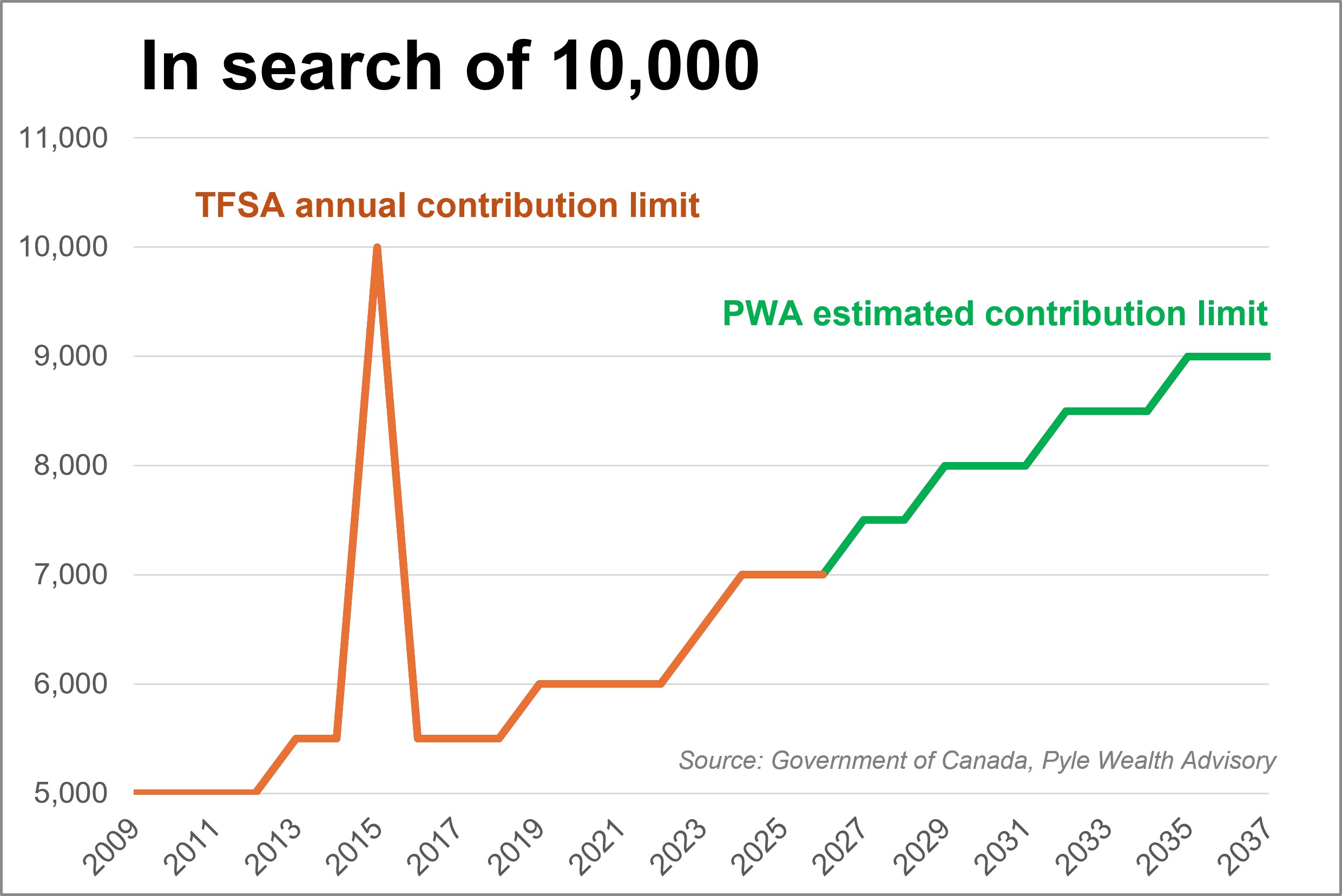
Let me begin with a little history lesson. The TFSA started life in 2009 with an annual contribution limit of $5,000. It spent four years at this level before getting adjusted to $5,500 for 2013 and 2014. In 2015, the Harper government bumped it up to $10,000. The Trudeau government chopped it back to $5,500 in 2016 and it remained there until 2019 when it was adjusted to $6,000. In 2023, it rose to $6,500 and in 2024 it was increased to $7,000 where it has remained through to this year. But how does it get adjusted for some years but not in others?
The annual limit started at $5,000 in 2009. Each year since, it is adjusted using a formula that incorporates the Consumer Price Index, and the result is rounded to the nearest $500. The CRA does not publish the unrounded figure, which is why outsiders can only estimate the next number. The unrounded amount keeps compounding underneath the published one, so a few years of modest inflation can pile up with no change in the headline limit, until the figure crosses a rounding threshold and the published limit steps up by $500. That is how the limit has stayed at $7,000 for three years.
While the government does not publish the raw adjusted TFSA limit, it can be estimated fairly easily, and I have done so for the coming year as well as the next ten years. Let’s start with the 2027 limit. Based on CPI figures for the 12 months ending in September, the adjustment factor produces a result of $7,376. Since that is above $7,250, the government has now confirmed that the 2027 contribution limit will be $7,500. As an aside, I originally wrote this section before Ottawa made the announcement, so thankfully there is no need for a disclaimer on my 2027 estimate.
Now, going forward, we have to make an assumption as to what the annual inflation rate will be. The Bank of Canada’s official target is 2%, and the suggested rate by FP Canada (the body that governs financial planners) is 2.1%. Yes, the inflation rate in September was 3.1%, but if we believe that the Bank will do whatever is necessary to keep inflation close to its target, then we can assume the long-term average will probably be close to 2%. In the chart below, I take that 2% average and estimate what subsequent TFSA limits will look like. As you can see, by 2037 we could have a contribution limit of $9,000. That still falls short of the one-time $10,000 limit in 2015, but a prolonged spate of above-2% inflation could get us there. Keep in mind, too, that legislation may change and directly affect TFSA contribution limits.
Rules and Tips Worth Knowing
1) If you do need to take money out, now is the best time of year
Our usual advice is to leave the TFSA alone and fund spending from other accounts first, because tax-free growth is hard to replace. But when a withdrawal can't be avoided, timing matters. The amount is added back to your contribution room on January 1 of the following year, not right away. A withdrawal in December can therefore go back in as early as the first days of January, so the money is out of the account for only a few weeks. A withdrawal in January means waiting nearly a full year to restore that room. The flip side is the penalty for getting this wrong: recontributing in the same calendar year, beyond your available room, creates an over-contribution taxed at 1% per month until it is fixed.
2) Consider a TFSA when gifting to children and grandchildren
Many parents and grandparents are eyeing the First Home Savings Account to help their children or grandchildren get into a new home. For someone who is confident about buying a home, the FHSA is hard to beat: contributions are deductible, and qualifying withdrawals for a first home are tax-free. But it only works well for a person who ends up buying. A young adult who isn't sure about a home purchase, or who may rent for years or move abroad, can find the FHSA a poor fit. (Unused FHSA funds can be moved to an RRSP, but they then stay inside the registered system and are taxable when withdrawn.) A TFSA has no such condition. The money can go toward a home, a wedding, a business, a car or retirement, and withdrawals restore the room. A gift of cash is not taxable to the recipient, who simply contributes it to their own account. The recipient needs to be 18 or older and a Canadian resident to open a TFSA.
A few other rules to keep in mind:
• Contribution room carries forward indefinitely, so unused room from earlier years is still there.
• Check your room in your CRA My Account rather than relying on your own tally, and remember that contributions at more than one institution all count against the same limit.
• Dividends from U.S. stocks held in a TFSA are subject to U.S. withholding tax that is not recoverable, unlike in an RRSP, which is worth weighing when deciding what to hold where.
• Losses inside a TFSA can't be claimed against gains elsewhere.
I know what you are all saying. Why do we celebrate a savings vehicle that is 18 years old but has given Canadians a cumulative tax shelter of $109,000? Hey, that’s better than the $50,000 maximum you get for your kid’s RESP over the same timeframe, but I digress. For our American friends, there will be a lot of turkey consumed, but some will want seconds. Here at home, we will take whatever seconds there are when it comes to moving investment capital into a tax-free environment.
On behalf of the Pyle Wealth Advisory team, have a wonderful week.
Andrew Pyle
Related posts
Andrew Pyle
July 03, 2026
There and back again
Markets in the first half of 2026 felt like a tough climb—steady gains, sharp descents, and unexpected turns. The ride mattered more than the distance covered.
Read moreAndrew Pyle
August 21, 2026
Who’s Actually in Tune with AI?
A guitar riff, a trade rant, and an AI reality check: the world is not adopting AI in harmony, and that mismatch may matter for markets.
Read more