




Andrew Pyle
November 20, 2026


Error 404: Rally not found
Okay, I am going to date myself a little here but there was actually a time before Claude (Anthropic's chatbot) gave you the best roast beef recipe and before there was such a thing as spam email. Back in the early internet days, systems were often unstable and we would get these frustrating error messages, generated from what we called the HTTP status code system. One of the most common errors occurred when you tried to visit a web page, but someone had moved it or removed it. The address was correct, but no one was home. Yes, that lovely message – 404 Not Found.
This week, a lot of investors clicked on the tech rally and got the same message. One client asked a very reasonable question. How is it that all the Artificial Intelligence (AI) enthusiasm we saw early in October has just evaporated? Indeed, the Nasdaq is back in correction territory, the biggest name in AI chips lost its founder-CEO, and then, as if on cue, Microsoft, the FAA, several big banks and United Airlines each had a 404 moment of their own in the space of five days. Three stories, one question: what do you do when the thing you were counting on is not there?
The wheels come off the tech rally
If you only looked at last Friday's close, you might think not much happened. The S&P 500 gained 2.5% for the week and the Nasdaq 2.3%, the best weekly showings since early August. But that was a bounce out of a hole, and it helps to remember how deep the hole was. The Nasdaq Composite set a record close of 27,599.9 on October 6. By the end of October, it had shed more than US$2.5 trillion in market value. Then came Thursday, November 5. The Nasdaq fell 5.5% in a single session, the worst day since April 2025. The chart below shows the Nasdaq index since the start of the year.
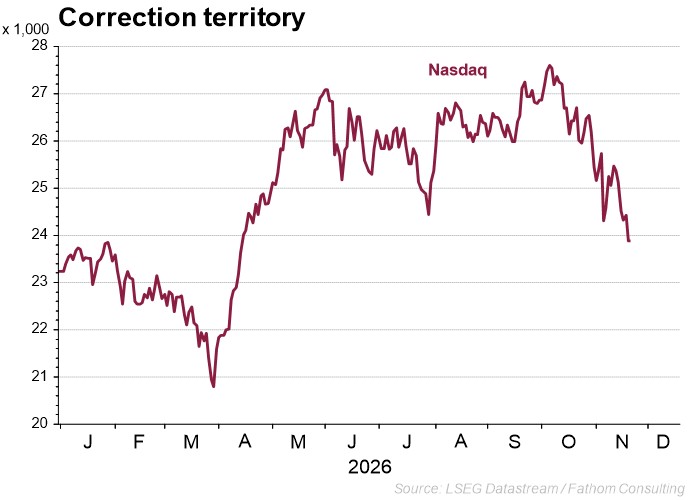
There was no single trigger. It was a pile-up: Qualcomm warning that a memory-chip shortage was hurting smartphone sales, growing scrutiny of data-centre buildouts and how they are financed, and a market that had just rallied hard on the U.S. midterm results and was due to be disappointed. The Nasdaq 100 then strung together four straight losing weeks before the bounce after November 5th, and the relief didn’t last, culminating in this week’s exhale, taking the index to the lowest level since April. Thursday brought another false dawn: Nasdaq futures had jumped overnight on news that Anthropic's IPO had priced above its range, but the gains evaporated once the shares began trading. As much as this latest drawdown has stung, it is smaller than past events.
How this compares with recent episodes
•April 2025, the tariff shock. The Nasdaq fell almost 23% from its 2024 record to April 7, 2025, then recovered to new highs. The culprit was policy, and policy reversed.
•March 2026, the Middle East war and oil. The Nasdaq confirmed a correction on March 26, nearly 11% below its October 2025 high, and was back at a record by April 15, a rebound of less than six weeks. The culprit was an oil spike that eventually eased.
•November 2025, the first AI-valuation scare. The Nasdaq had its worst week since April on valuation worries and then shrugged it off.
The pattern in all three: an outside shock, a sharp drop, a quick repair. What worries me this time is that the culprit is perhaps inside the trade. The AI build-out is being questioned on its own economics (pace, cost and financing) just as the rate backdrop turns the wrong way. October CPI printed +0.4% against +0.3% expected, Fed Governor Waller floated a half-point hike for December, and markets are now pricing a December hike as a near certainty. Higher rates are hardest on exactly the long-duration, richly valued assets that led this rally. That is the December-hike story I have been telling, now arriving with an AI-sized valuation attached. I am not calling the end of AI. The March rebound shows how quickly sentiment can reverse. But "buy the dip" worked in 2025 and 2026 because yields were falling or oil was easing. Neither is true today. There are other dents in the AI armour though.
Nvidia: great numbers, shaky story
On November 12, Jensen Huang resigned as CEO amid reports of extramarital affairs, including a relationship with a woman U.S. intelligence officials reportedly believe is a Chinese spy. An SEC probe has also been reported. The new chairman said the board does not intend to reinstate him, and CFO Colette Kress is serving as interim CEO while keeping her finance role.
Then Tuesday's earnings arrived and the business looked fine. Revenue was $115.8 billion, more than double a year ago and well ahead of the roughly $109 billion analysts expected, with earnings beating by about 20 cents a share. The stock rose as much as 5% after hours. So, the business was not the problem. The problem is everything around it: a founder-led governance question, China exposure (short seller Culper Research claims as much as 20% of fiscal 2026 compute revenue was China-driven, a claim Nvidia has not accepted), and Ms. Kress's own acknowledgement that pushback against data centres is "an area to focus on." When the market's favourite stock needs a perfect quarter and a clean narrative, a messy story gets punished even when the quarter is perfect.
Anthropic IPO: Humpty Dumpty?
The Anthropic IPO is the other dent, and it is a subtler one. Backers were telling the Financial Times in August to expect a $2 trillion-plus listing. By mid-October, after the investor day, reports were that investors were discussing about $1.5 trillion. On November 10 the marketed range of $70 to $78 a share implied roughly $1.26 to $1.41 trillion – significantly lower than the $2 trillion that bulls had been throwing around over the summer.
Wednesday night the deal priced at $83, above the range, raising a record $81.3 billion, or about $107 billion once a private placement is included. On Thursday the stock opened at $111.50, 34% above the issue price, at an implied value of about $2 trillion, which briefly put Anthropic back at the number that was whispered in the summer. It did not stay there. By the close, shares were near $97 – still higher than the IPO price, but down from the peak. To make matters worse, Bloomberg news reported that Apple had a job posting for a manager for an autonomous AI agent that can write code, browse the web and execute other tasks that a user might want.
Two things stand out. First, supply: about $107 billion of new Anthropic stock arrived in a market that lost more than $2.5 trillion in October, and the broad indexes slid as soon as it began trading, with CNBC attributing the drop to investors taking profits. Second, Nasdaq futures were up more than 2% overnight on the pricing news, and the gains were gone within minutes of the first trade. When a market rallies into an event and sells the event itself, it is telling you how much was already priced in. OpenAI has reportedly pushed its own listing to next year, which suggests the window is not as wide open as it looked in June.
Put Nvidia and Anthropic side by side and the message is the same, with a twist. Strong results are no longer enough on their own, and even a record debut was not enough to hold a rally. The market is asking who pays for the build-out, and what happens if growth slows from spectacular to merely excellent. This is a story that Ally and I have been telling for the past year and is the central reason why we have underweighted the US market in general and have further minimized exposure to direct AI names.
When the market sell-off meets a bad week for the plumbing
A falling portfolio is hard enough to watch. It is harder when the same week keeps handing you reasons to wonder whether things are breaking. Here is the sequence, per news reports and official statements:
•Thursday, Nov. 12: a Microsoft 365 outage disrupts Outlook and Teams for nearly 24 hours. Microsoft cited a previously undetected software defect, increased traffic and reduced server capacity.
•Friday, Nov. 13: the FAA orders a nationwide ground stop of departures for nearly five hours (about 3:30 to 8:15 p.m. ET). About 12,462 flights were cancelled, though the FAA noted not all cancellations were caused by the ground stop, and every aircraft landed safely. Transportation Secretary Duffy said the trouble began as contractor L3Harris was replacing copper wiring with fiber. The same day, payroll and HR provider Workday locked users out.
•Monday, Nov. 16: customers of Chase, Bank of America, Wells Fargo and U.S. Bank reported trouble with online banking, and some reported Zelle delays. Chase traced its issue to a software release rolled out that day. United Airlines reported a systemwide outage affecting departures, later resolved.
•Tuesday, Nov. 17: brief disruptions at the National Weather Service, Apple's App Store and services, Marriott sign-ins, and some NSA internal systems during maintenance.
Officials have said they see no evidence the events are linked to each other or to malicious actors, and the FAA has paused new router installations while it investigates. The causes cited so far are mundane: a software defect, a wiring upgrade, a bad release. This might be reassuring about the “what” but not so reassuring about the “so what?”. A lot of critical infrastructure runs on a small number of systems, and ordinary mistakes can have extraordinary reach.
The point is not to panic, but to have a plan
This is where the portfolio conversation and the plumbing conversation turn out to be the same conversation. Over the past week I have found myself answering the same questions from clients: should we have an emergency plan, and what would it include? What happens if the grid goes down? What do I do if I cannot access the funds I need electronically or even at an ATM? First and foremost, having a solid contingency/emergency plan does not require a threat of nefarious actors or rogue AI. Climate events, for example, can easily disrupt access to food and supplies. So, stepping away from portfolio talk, here is the framework I would offer, in the order I would work through it:
1.A modest cash cushion at home. Card networks and bank apps failed for hours this week, not days. A few hundred dollars in small bills, not a stash under the mattress, covers the awkward gap.
2.Have enough essentials to last more than a few days. Remember the toilet paper experience of COVID?You get my drift, but this extends to water, food, and even fuel. And, as a loving pet-owner, do not forget the furry pals around you.
3.Know where your information lives. Keep a short paper list of key phone numbers, account contacts, insurance policy numbers, and where your will and powers of attorney are kept. If email or the cloud is down, you should still be able to reach your advisor, your lawyer and your family.
4.A household plan. The federal government's long-standing guidance is to be ready to look after yourself for at least 72 hours: water, food, medications, a flashlight, a battery or crank radio, and a plan for where family members would meet or check in. Many people will want more depth than that, especially in rural areas where outages can last longer.
5.Talk it through while it is calm. A plan nobody has discussed is not a plan. Ten minutes with your spouse or family now is worth more than any supply list.
Notice the thread. A portfolio concentrated on a handful of AI names, a business that runs on one email vendor, and a household with only one way to pay for groceries all share the same weakness. Diversification is not only an investment idea. It is how resilient systems are built, and this week gave us a reminder of why.
On behalf of the Pyle Wealth Advisory team, have a wonderful weekend.
Andrew Pyle
CIBC Private Wealth consists of services provided by CIBC and certain of its subsidiaries, including CIBC Wood Gundy, a division of CIBC World Markets Inc. “CIBC Private Wealth” is a registered trademark of CIBC, used under license. “Wood Gundy” is a registered trademark of CIBC World Markets Inc.
This information, including any opinion, is based on various sources believed to be reliable, but its accuracy cannot be guaranteed and is subject to change. CIBC and CIBC World Markets Inc., their affiliates, directors, officers and employees may buy, sell, or hold a position in securities of a company mentioned herein, its affiliates or subsidiaries, and may also perform financial advisory services, investment banking or other services for, or have lending or other credit relationships with the same. CIBC World Markets Inc. and its representatives will receive sales commissions and/or a spread between bid and ask prices if you purchase, sell or hold the securities referred to above. © CIBC World Markets Inc. 2026 CIBC Wood Gundy, a division of CIBC World Markets Inc. Insurance services are available through CIBC Wood Gundy Financial Services Inc. In Quebec, insurance services are available through CIBC Wood Gundy Financial Services (Quebec) Inc.
The CIBC logo and “CIBC Private Wealth” are trademarks of CIBC, used under license. “Wood Gundy” is a registered trademark of CIBC World Markets Inc.
Andrew Pyle is an Investment Advisor with CIBC Wood Gundy in Peterborough. The views of Andrew Pyle do not necessarily reflect those of CIBC World Markets Inc.
Clients are advised to seek advice regarding their circumstances from their personal tax and legal advisors.
Related posts
Andrew Pyle
March 20, 2026
Stuck between Iran and a hard place
Global central banks should have had an "easy" 2026, but the Iran war has put them in a bind. Fight inflation from higher energy prices or protect against recession. Talk about a tight spot.
Read moreAndrew Pyle
January 31, 2025
No disruptions please, we're central bankers
The Bank of Canada and Federal Reserve held their first policy meetings of 2025 and while the decisions and messaging were different, they share one source of uncertainty in common.
Read more