




Andrew Pyle
November 13, 2026


Take two and call me in December
I had convinced myself that the worst was behind me. The cold that wouldn’t quit finally seemed to be fading, and I was back in the gym, pushing the envelope, and getting the guitar out again – a “normal” week, in other words. Then it came back, and this time with a prescription attached: two pills a day, take them as directed, and check back if things don’t improve. That is the doctor’s version of “take two”. A second pass at a problem you thought you had solved.
I can’t help noticing that markets are in a very similar spot. Last week, we wrote about the US midterm elections and what the results might mean for investors. Market volatility notwithstanding, the initial relief after the blue wave felt real. Uncertainty seemed to clear and the market consensus settled into what I would call a comfortable story. But just like my cold, the underlying condition didn’t go away because we decided it should. This week’s events, from a hot US CPI report to news that the CEO of the world’s largest tech company has been out sowing seeds in addition to making chips, suggest it is time for take two.
The comfortable story
When the results came in, markets exhaled. Democrats took both the House and the Senate, and by Wednesday morning the narrative had written itself. The day after, the S&P 500 rose 1.4% to roughly 7,700. The 10-year Treasury yield slipped to about 4.89%, the US dollar index softened, and gold jumped more than 3% to around $4,060 an ounce. WTI crude fell about 8.5% on talk of an end to the Iran war. As we know, the rest of the week wasn’t exactly a picnic, but the premise for the initial reaction is still circling. It was a tidy story, and it rested on three planks:
- Gridlock means restraint. A divided Washington has less ability to spend, which is supposed to be good for bond yields.
- Cheaper oil means relief. Lower energy prices take some pressure off inflation.
- The White House would keep the Fed in check and largely behave itself. After months of the President insisting that rates should be lower, most of us (myself included) assumed the Oval Office would lean hard on the Fed not to hike. Trade? Deals. Iran? Deal.
The first two planks are at least arguable. It’s the third one I want to put under the microscope this week.
The prescription is already written
The Fed doesn’t appear to have read the same script. On September 16, the FOMC raised the funds rate a quarter-point to 3.75% to 4.00%, a unanimous 12-0 vote and the first hike since July 2023. It held steady in October, but added language that economists read as teeing up another move in December, with two hawkish dissents underscoring the bias.
Then came this Tuesday’s October CPI. Headline inflation rose 0.4% on the month and core rose 0.3%. This followed a September report that had already pushed the annual rate to 3.7%, with gasoline doing much of the damage. Within hours, futures were pricing roughly an 85% chance of a quarter-point hike on December 9 and about 15% for a half-point. The odds of the Fed doing nothing have effectively vanished. Governor Waller had signaled ahead of the report that a hot core print could justify a larger move, and Chicago Fed President Austan Goolsbee called the report “borderline disturbing.” And just so we are clear, Waller is a Trump appointee and someone we thought would lean with the President against raising rates. As the chart below shows, there is a lot of territory through which this Fed could take rates if inflation pressures don’t ease.

Now consider the other side of the ledger. After September’s hike, the President posted that rates “should be 1%, or less,” but he stopped short of attacking Fed Chair Kevin Warsh, blaming a “hostile board” instead. That was a far cry from the personal broadsides Jerome Powell used to receive. So here is the setup. The Fed has told us it is prepared to hike. The data is giving it the reason. And the one force we assumed would stand in the way has, so far, been oddly quiet.
Scorched earth, revisited
Here is the question I keep coming back to. Before November 3, a Fed rate hike carried a political price tag for the White House. Higher borrowing costs, a wobbling stock market and a squeezed consumer are not what any administration wants to explain to voters, that is if the goal is to keep the team in power. That price tag disappeared last week. The voters have spoken, the next election is two years away, and a President with less to lose may simply decide that a December hike is not worth the fight. That is what I mean by a scorched earth period. It is not a forecast, and I want to be careful about that. Mr. Trump’s restraint toward Warsh in September could just as easily mean he is content with his pick. It is, however, a risk, and I’m not sure investors have priced it in. But scorched earth extends beyond leaving the door open for the Fed to raise rates at will.
How about tariffs? The White House has been preparing for this moment. News reports said officials spent months identifying executive actions that can advance the agenda without Congress, including new tariffs on critical minerals and wind turbines and tighter visa rules. Some have noted that the President’s tariff authority and deregulatory push remain intact, even as Democrats gain new powers to investigate and challenge those actions when they take control in January. Yes, the courts have
blunted some of his tools, but they haven’t taken them out of his toolbox.
Thursday gave us a live example. In a Truth Social post, Trump said Mexico must stop migrant caravans heading north “NOW,” and that if it doesn’t, “the Tariffs on Mexico will be IMMEDIATELY DOUBLED.” To be precise, this is a threat, not an enacted order. No deadline was given, and I haven’t seen a formal action. Mexico News Daily reports that the duties at stake include the steel, aluminum and vehicle tariffs Mexico has been negotiating to reduce. President Sheinbaum responded that no caravan has reached the northern border since January 2025 and that her government will rely on persuasion rather than force. As for Canada, we are in a state of limbo with respect to a new deal on trade with the US.
What caught my eye though was a phrase in the same bombastic post. Trump referred to “the perceived loss by the Republicans in the Midterms.” Ten days after the election, the result is already being described as merely “perceived,” and a tariff threat is being aimed at a migration issue, not a trade one. That is not the posture of a President settling into gridlock. Again, Canadian readers will recognize the pattern from our own trade disputes.
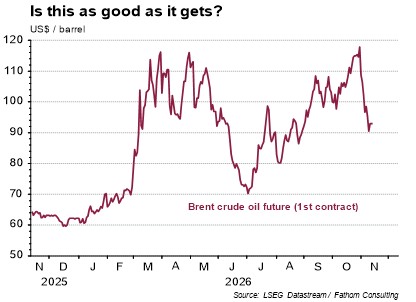
Then there is Iran. The post-election drop in oil was a bet on peace, and so far, it has held. As of Tuesday, Brent was around $91 and WTI around $85, both down roughly 20% this month on hopes for a deal, as you can see in the above chart. Mr. Trump spoke of “positive momentum” toward ending the war after meeting Qatar’s prime minister and said a return to fighting was “highly unlikely.” Then on Thursday, Trump said the US does not need a deal and that the time for one has passed. In response, oil prices pushed higher. Before the election, many expected him to resume attacks on Iran this month. Today, who knows.
That gives a President with less to lose two very different switches. A deal sends oil lower and gives the Fed some breathing room, which would be the best off-ramp for our take two. Renewed strikes push oil the other way, straight into the inflation numbers the Fed is watching. The market has leaned toward the first outcome, and the second looks underpriced to me.
What could go wrong with the comfortable story?
There are a few ways the comfortable story goes sideways. With less aggressive rhetoric from Trump on rates, the Fed decides to wrest inflation under control and hikes rates half a point in December. Add tantrum-related tariffs and oil to the mix, and the inflation risk compounds, supporting the Fed in a more aggressive decision. That is the opposite of what the post-midterm rally assumed.A resumed offensive against Iran would only add to these risks. We should also acknowledge the possibility for deflection. No, not from the “files” and not the election, but perhaps in response to the growing scrutiny around Nvidia and how close it leads to the administration.
None of this says that bond and stock markets have to fall. I’m simply suggesting that the market’s explanation for the rally may be incomplete.
The year-end wrinkle: tax-loss selling
Okay, let’s leave the macro world for a moment and focus on more tax-related issues that investors might be thinking about. This is the time of year when we sit down with portfolios and look for losses to offset the gains realized over the year. Tax-loss activity tends to peak from mid-November to mid-December, and there is an old pattern that goes with it: many of the stocks sold for tax reasons turn out to be winners after the calendar turns, once the selling pressure lifts. This year, the macro backdrop could complicate that pattern. If investors adopt a risk-off posture on a December hike and a more aggressive White House, two things could happen at once.
1. More gains get realized. Investors trimming winners to cut risk crystallize gains they didn’t plan to, which raises the demand for losses to offset them. Another point to consider here is that investment firms (fund managers) often do a little window dressing. No, I’m not talking about the Christmas windows that the Toronto Simpsons store would decorate this time each year (okay, I am dating myself). I’m referring to the incentive to lock in gains before year-end so that it makes the marketing materials look better going into the new year. Fund managers will sometimes bank gains late in the year to protect a good year’s returns, and some tidy up their holdings so the laggards don’t show up in year-end reports. Either way, we could see heavier selling in both recent “winners” and recent “losers”.
2. The usual candidates get hit harder. If more people want to harvest losses at the same moment the broader market is soft, the stocks already on everyone’s list of laggards face extra pressure just when they would normally be bottoming.
I don’t know that these forces will materialize and I’m not forecasting as such, but it is worth thinking about. It does suggest that the seasonal rebound in tax-loss names may arrive later, or smaller, than the textbook pattern would suggest.
Here are a few practical points for the weeks ahead:
- Tax decision first, market call second. Whether a loss makes sense to realize depends on your gains this year, past gains you can carry losses back against (up to three years) and your plans going forward. Timing the bounce should not drive it.
- Mind the calendar. For Canadian-listed securities, the last trade date that settles in 2026 is Wednesday, December 30. The TSX is closed on December 25 and December 28, and it closes early on December 24, so the real window is tighter than it looks. Most advisors prefer to get this done by mid-December.
- Watch the superficial loss rule. If you, your spouse or a corporation you control buys the same security within 30 days before or after the sale, the loss is denied. That includes purchases in an RRSP or TFSA.
As we consider the potential “take two” paths markets might follow in the coming weeks, it’s important to remain aligned to your own specific investment strategy. Our job is to make tactical course changes, when needed and when appropriate. In the meantime, I’ll keep following the doctor’s orders: take two and check back in December.
On behalf of the Pyle Wealth Advisory team, have a wonderful week.
Andrew Pyle
Related posts
Andrew Pyle
June 19, 2026
You Can't Always Get What You Want
US-Iran deal brings market drama: stocks tease record highs, oil prices drop, and the Fed plays hardball. Just like the ride—sometimes you get surprises, not what you want!
Read moreAndrew Pyle
April 10, 2026
Dow Transports – Strength or mirage?
A sharp rebound in the Dow Transports may look impressive, but beneath the surface, weak shipment volumes and reliance on fuel surcharges suggest the rally may not be as solid as the numbers imply.
Read more