




Andrew Pyle
October 30, 2026


The Road Less Hiked
With Halloween tomorrow, I had a hard time resisting the temptation to write about something scary and spooky today. What with the nonsense brewing in the mid-term cauldron and ghastly revenue misses in the tech space, there would be no fear of the black cat getting my tongue. But resist I must and so I thought I would talk about something that used to represent a large chunk of my previous day job – monetary policy.
Within hours of each other this past Wednesday, two central banks looked at the same oil-driven inflation problem yet reached opposite conclusions. The Bank of Canada (BoC) raised its overnight rate by 25 basis points to 2.5%, while the Federal Reserve left its target rate range at 3.75-4%. While there was broad consensus among market participants for both decisions, to the casual observer the divergence may have appeared out of whack with what the fundamentals have been telling us. Canada has the weaker economy and, by the latest CPI figures, the lower inflation rate. And even though the move higher by the Bank could be seen as just catch up to the quarter-point hike by the Fed last month, still it could be questioned. Indeed, clients have been asking Ally and me this week whether Canada can withstand this rise in interest rates.
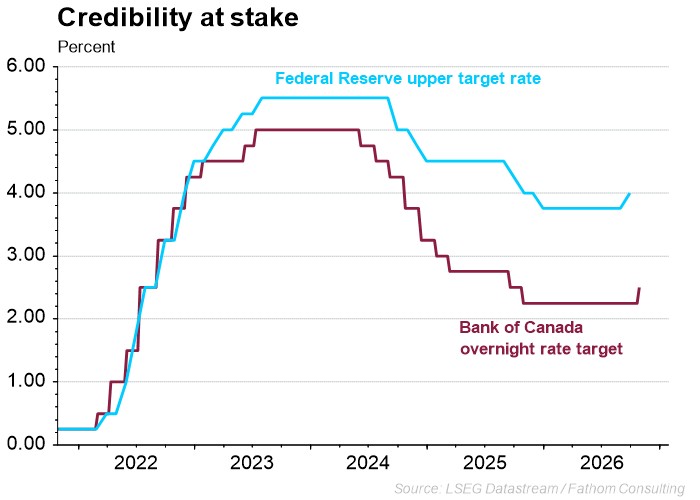
Credibility is cheaper to keep than to rebuild
I understand the objection. Canada lost 68,000 jobs in September and unemployment reached 6.5%. Hiking into that is uncomfortable, and critics will say the Bank is fighting the last war. But a central bank that only acts once the data is unambiguous is a central bank that acts late. The case for the BoC hike rests on expectations, not on today's CPI. The Bank's own business survey showed inflation expectations are rising, and that's the signal central bankers fear most. Once firms and households start building higher prices into their decisions, the cost of getting them back is far greater than the cost of a quarter point now. Governor Tiff Macklem highlighted that these higher inflation expectations will result in a greater cost pass-through in 2027. As such, the Bank now projects that inflation will rise to 3.5% by the end of this year and hover around 3% next year. That is a full percentage point higher than what it forecast back in July. The other thing different between this month and the summer is that the Canadian dollar has given up a lot of ground against the US dollar.
Echoes of the Monetary Conditions Index
Back at the start of the year, the Loonie was trading north of 74 US cents, and it was believed that higher energy prices would support a new cyclical upturn in the currency. Instead, it has seen a series of lower highs and lower lows, and tested 70 cents, which was the lowest since April 2025. There had been a recovery in the last couple of weeks, but it was still trading below 71 cents before the BoC meeting.
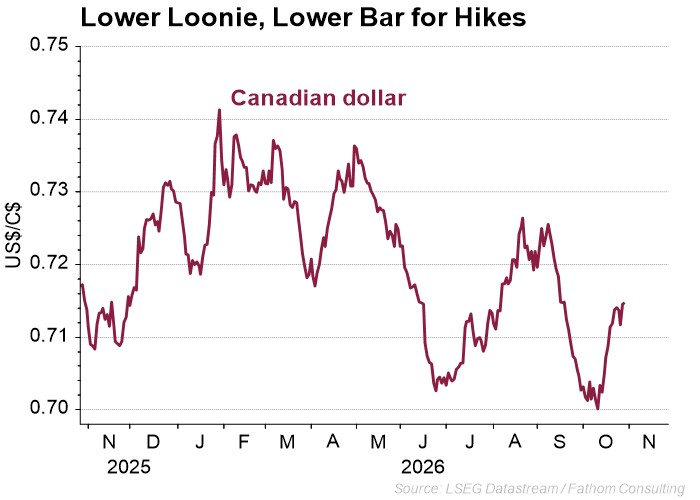
There was a time when the Bank of Canada treated the dollar as a policy tool. Under Gordon Thiessen in the 1990s, the Bank tracked what was called the Monetary Conditions Index, which combined short rates and the exchange rate into one gauge. Without getting into a lot of math, basically it formed a relationship between the two. A weaker Loonie loosened conditions, similar to how a lower interest rate would, and vice versa. If the Bank wanted to offset a drop in the value of the currency, because it did not want monetary conditions to loosen, it could offset it with a higher rate. The relationship was basically that a one percentage point change in the Bank of Canada rate was equivalent to a 3% decline in the value of the Canadian dollar. Flip it around and it suggested that a 1% decline in the Loonie was like roughly a 30 basis point cut in the Bank rate.
Back then I was head of strategy for the Canadian treasury desk of a large European bank and this became a mechanism with which you could “trade” money market instruments based on how you thought the BoC would react to a certain move in the currency. The Bank eventually retired the formula, because a mechanical rule proved a poor guide. It also was unable to differentiate between movements in the Loonie that came from a real shock to the economy and a portfolio one.
What survived was the principle: the currency matters. With higher inflation in the U.S., a lower exchange rate could potentially result in that higher inflation being imported into Canada, thus working against the Bank’s objective. It could also reinforce rising inflation expectations. Bottom line, the Bank weighed the economic consequences of higher rates against the risk of losing credibility and chose the latter – as it should have.
The guidance vacuum
Where the Bank explained itself, the Fed went the other way. As much as Chair Warsh is still new at the job, there was a time when this situation would call for the Fed chief to lean more hawkishly in order to establish credibility. Indeed, Warsh was pretty up front in the summer when telling us that there was no way the Fed would allow inflation to go unchecked. If it was persistently above target (I would say 3.7% is sufficiently above the 2% target), then rates would go up. And so they did in September, but this month’s inflation report was even worse than the last one. Surely there was justification for a second hike? Unfortunately, the proximity to the mid-term election next week and whispers from the oval office about the need for low rates combined to give us a stand-pat verdict. Again, no one expected anything different, which is troubling in itself, and thank goodness there were two FOMC members that dissented against the decision and voted for a hike. This wasn’t the biggest problem with this Wednesday’s outcome.
We know Warsh has no appetite for forward guidance outside a crisis, doesn't submit his own forecast to the quarterly projections (dot who?), and has presided over shorter statements and shorter press conferences. This week he added a new wrinkle: of the Fed's eight meetings, one in 2027 and two in 2028 will be set aside for broad strategy, with no rate vote and no policy statement. That leaves seven decision points next year and six the year after. The rationale is that the Committee needs protected time to think about the big questions, and I don't buy it.
Shouldn’t Fed officials and staff be thinking about big macro themes all the time? If they need time together, can’t they add a session or hold one by video, as they have before? Nothing requires taking a decision date off the calendar, least of all when inflation is running above target and the next shock could land at any time. A policy meeting with no vote and no statement is a séance with no one taking notes.
Some will say that fewer policy meetings and less guidance is a perfectly defensible philosophy. But it has a price, and markets are the ones paying it. When the central bank for the world's reserve currency steps back from forward guidance, investors don't stop forecasting. They price in a risk premium instead, in term premium, in the dollar, and in the long end of the curve. We saw some of that this summer, when the 30-year Treasury pushed through 5%. A Fed that tells you less leaves you less certain about the discount rate on everything.
Same shock, different reaction function
Both banks are staring at the same oil price. They simply disagree on how much of it to look through. The Bank judged that energy costs were feeding into expectations. The Fed, for now, is treating them as something it can watch. We've written a lot about the refining squeeze this fall, and it's the common thread that makes the divergence so interesting. The Bank of Canada raised its overnight rate knowing it would be criticized, because it judged that letting inflation expectations drift would cost more later. The Fed held and left markets to guess about December. Each choice is defensible on its own, but together with the Fed’s retreat from communication, they leave investors with less to hold on to.
The same dynamic runs through the rest of what's pricing global markets: trade policy that shifts from one week to the next, geopolitical decisions with consequences that reach pump prices and shipping costs, and a US fiscal path that few believe will hold. Markets can live with bad news. What they struggle to price is the absence of a reliable framework, and this week the Bank gave us one while the Fed took a step back from it.
From a portfolio perspective, one or two more increases in the Bank of Canada rate will not have a material impact on the Canadian economy in our opinion. However, another misstep by the Fed on inflation following the 2021 delay could require a more aggressive tightening in policy after the mid-terms. That is not going to be welcome news for a bond market that is having to inhale an ever-increasing supply of AI-related new debt issuance or that other part of the K-shaped economy that needs stocks to keep rising.
On behalf of the Pyle Wealth Advisory team, have a wonderful weekend.
Andrew Pyle
Related posts
Andrew Pyle
July 07, 2026
BNN Bloomberg The Open - July 7th, 2026
Andrew joined BNN Bloomberg July 7th, 2026 to provide an outlook on the markets for the second-half of 2026.
Read moreAndrew Pyle
June 19, 2026
You Can't Always Get What You Want
US-Iran deal brings market drama: stocks tease record highs, oil prices drop, and the Fed plays hardball. Just like the ride—sometimes you get surprises, not what you want!
Read more