




Andrew Pyle
October 16, 2026


Lost at C
With the trip out east and the unfortunate passing of Ben’s dog, there was a three-week gap between guitar lessons and, while I did take my Gibson GS mini with me out to Nova Scotia, practice time was not voluminous. Hence, this Tuesday’s sit-down was, shall I say, a little rusty. My problem is that I will usually lead into these sessions by recalling a song I had recently heard or a concert that Pam and I had seen. Last weekend we watched a 1997 concert by Fleetwood Mac, and I commented on how amazing Buckingham’s fingerpicking was. So, Ben takes out a blank sheet and writes out a few bars of Landslide. It looked easy enough, but wouldn’t it have to start with the dreaded C chord? Given my thick untrained fingers, I would
much rather strum the open strings with nothing pressed down. But Ben reminded me that if you don’t get C right, you really don’t get Landslide.
The same applies to the economy and some weeks back, I argued that analysts were overlooking personal consumption, or C in that most basic of macroeconomic identifiers: GDP(Y) = C + I + G + X – M. In the case of the US economy and many in the developed world, consumption makes up the largest slice of GDP. The problem is that if you don’t get C right here, you can actually get a landslide.
Is the consumer’s tank running dry?
Consumption is roughly 68% of U.S. GDP, according to the U.S. Bureau of Economic Analysis. During the AI euphoria, however, most of the attention has gone to business investment: the data centres, the chips and the capital expenditures that feed the underlying infrastructure. Fair enough, since business investment excluding housing grew 9% in the second quarter. But it was the consumer who carried that quarter, with spending up 3.8% annualized in the third estimate. The question is how that spending is being paid for.
In August, real spending rose 0.6% while real disposable income was flat, and the saving rate fell to 4.1%. PCE prices are
running 3.4% above a year ago. Households have been drawing down a cushion, and a cushion is not a trend. This week’s September figures were more eye-opening. On the surface, September US retail sales were fine: up 0.8% against about 0.3%
expected, after August was revised up to 1.3%. But strip out gas stations and the gain was just 0.2%. The so-called “control group”, which factors into the quarterly personal consumption expenditures, was up only 0.1% on the month. It’s not that more gallons of fuel were being pumped into cars, it’s that the prices of those gallons were higher. And it extends beyond fuel sales. The overall volume of what American households purchased last month looked soft, which suggests Q4 consumption may also be weak.
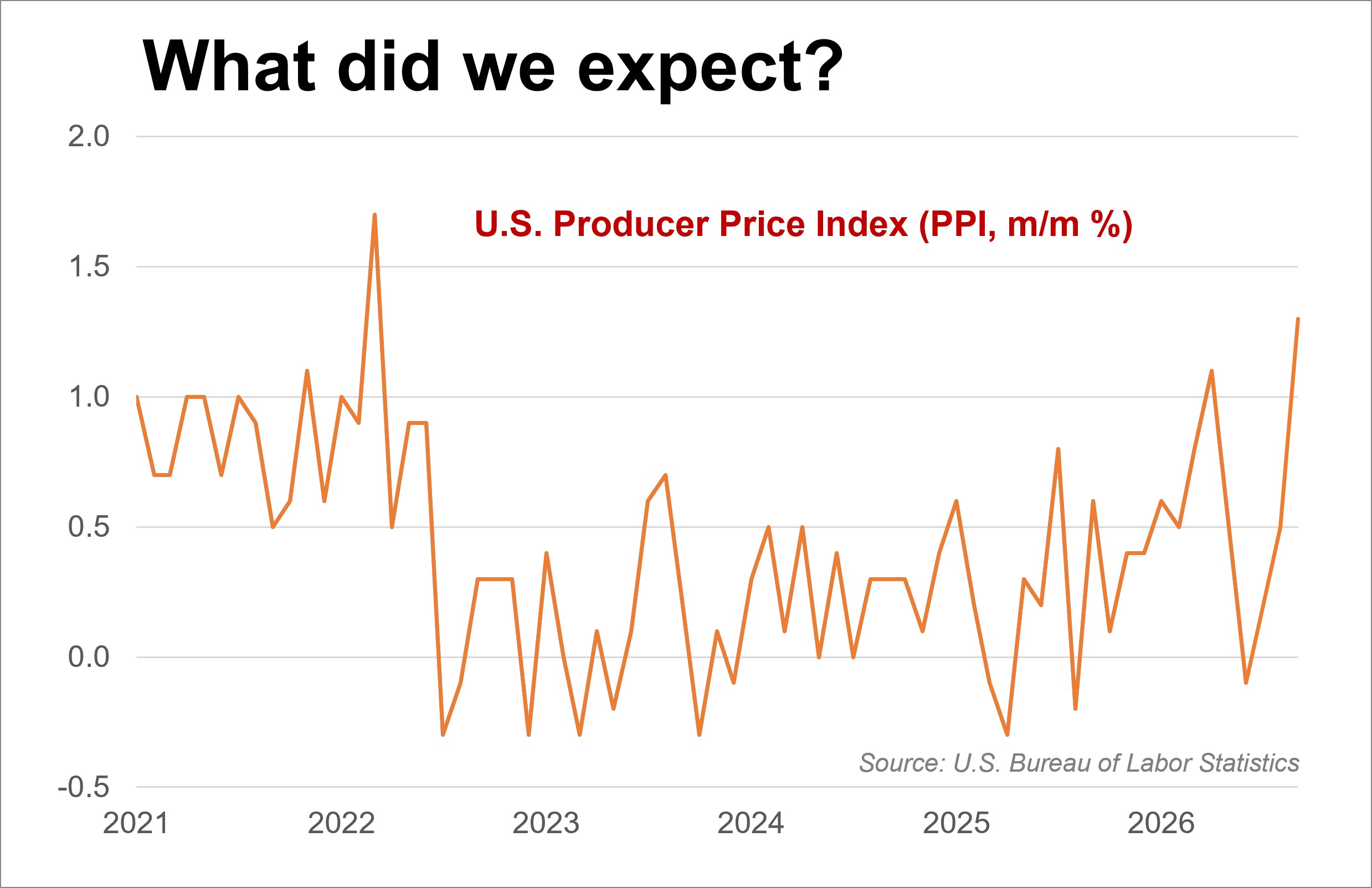
Wholesale prices were an even bigger surprise this week. The producer price index rose 1.3% in September against 0.5% expected, lifting the annual rate to 6.3% from 5.6% and well above the 5.3% forecast. Energy accounted for roughly 80% of the 2.9% jump in goods prices, with the Iran war at the root. Wednesday's CPI was also hot, up 0.6% on the month, giving us a 3.7% annual pace of inflation, while core inflation also nudged higher to 2.6%. As much as the market still thinks the Federal Reserve will resist lifting interest rates at this month’s FOMC meeting since it is right in front of the midterm elections, if it doesn’t move on these latest inflation stats, Chairman Warsh and crew could be accused of acting according to politics, and not fundamentals.
But there is a second leg to the lost C story. A good part of the spending comes from higher-income households who feel wealthy because AI-linked equities are high. Oxford Economics' Michael Pearce has argued that growth has increasingly leaned on that wealth effect and is exposed if AI optimism reverses. Thursday's AI-stock wobble was a small taste of that risk. Who is doing the spending matters as much as how much. Moody's research has put the wealthiest 10% of Americans at nearly half of consumption and about 87% of equity holdings. When the top of the income ladder leads, a stock market correction travels straight into the spending data, while many middle- and lower-income households are already feeling the pinch of higher fuel prices.
To be fair, other strategists have shown the consumer, not AI, drove US growth in 2025, so this is not a claim that C has been forgotten. My point is narrower: in my view, markets are treating C as durable when its funding is not. The question is whether other segments can pull enough weight to counter the drag.
The I is smaller than it looks
The accounting matters here. In Y = C + I + G + X - M, imports are subtracted, and much of the AI buildout is imported hardware. In the second quarter, imports rose at a 12.6% annualized pace, partly on chips and equipment for AI, and took about 1.7 percentage points off GDP growth. That is why the headline of 2.2%, revised up from 1.5%, undersells the strength
underneath: a measure of private demand that strips out government and trade grew at 4.6%. In other words, AI capex is real and large, but it adds less to measured GDP than its headline dollars suggest, which makes the consumer's share of the story bigger, not smaller. That cuts both ways for my thesis. It argues C deserves more credit, and it raises the stakes should C begin to fade in a meaningful way.
The good news is that the seesaw is back, for now
This week was a reminder, at least, of how bonds and stocks are supposed to behave. Despite the hot PPI, Treasury yields fell as investor anxiety over the dip in AI-related stocks led to a shift in capital flows into bonds. At the time of writing, the U.S. 30-year yield was trading down more than 0.2% below the high seen in the first week of this month, but it is still 0.8% above the March lows. Still, stocks down and yields down (bond prices up) is a sign that the teeter-totter is doing its job, and a welcome contrast to 2022, when prices of stocks and bonds fell together. But notice the driver: equities fell first and bonds were the refuge, not inflation cooling. If inflation stays hot while growth slows, yields could rise even as equities fall – something we have been acutely attuned to since the Spring. Wednesday’s tape showed how fragile that relationship is. After the hot CPI on Wednesday, the 10-year yield rose about 0.08% to 5.30% while the S&P 500 tumbled more than 80 points to 7,718 – a little more like 2022 than investors wanted. On Thursday, equities cracked and bonds caught the bid. A relationship that flips from day to day is not yet a regime.
A weaker consumer helps bonds. Hot producer prices hurt them. Which force wins is the question for the next few months.
What does this mean for portfolios?
Nothing here is a call to abandon equities or a prediction that a recession is on the way. The consumer has been resilient, and resilience can last longer than skeptics expect. But a few principles matter more when C's funding is thin and inflation is running hot:
• Look past the headline. Strip out fuel and price effects before drawing conclusions about demand, as with Thursday's retail sales.
• Favour balance-sheet strength and pricing power. Companies that can pass on costs and fund themselves are better placed if consumers pull back.
• Don't assume bonds always hedge. Thursday's rally came from a flight to safety, and an inflation shock can hit both sides of a balanced portfolio. Furthermore, it is still not time to load the truck up on longer-dated bonds. Governments continue to dig a deeper deficit hole, and AI-related companies are having to borrow even more to fund this near-mania tech buildout.
• Revisit concentration. If AI-linked stocks drive both your returns and the wealth effect behind spending, those two risks are more connected than they appear.
In the AI story, the C is the letter doing the heaviest lifting and the one with the thinnest support. It deserves a place on the
dashboard. Just like that C chord taunts me from the fretboard.
On behalf of the Pyle Wealth Advisory team, have a lovely weekend.
Andrew Pyle
CIBC Private Wealth consists of services provided by CIBC and certain of its subsidiaries, including CIBC Wood Gundy, a division of CIBC World Markets Inc. “CIBC Private Wealth” is a registered trademark of CIBC, used under license. “Wood Gundy” is a registered trademark of CIBC World Markets Inc.
This information, including any opinion, is based on various sources believed to be reliable, but its accuracy cannot be guaranteed and is subject to change. CIBC and CIBC World Markets Inc., their affiliates, directors, officers and employees may buy, sell, or hold a position in securities of a company mentioned herein, its affiliates or subsidiaries, and may also perform financial advisory services, investment banking or other services for or have lending or other credit relationships with the same. CIBC World Markets Inc. and its representatives will receive sales commissions and/or a spread between bid and ask prices if you purchase, sell or hold the securities referred to above. © CIBC World Markets Inc. 2026 CIBC Wood Gundy, a division of CIBC World Markets Inc. Insurance services are available through CIBC Wood Gundy Financial Services Inc. In Quebec, insurance services are available through CIBC Wood Gundy Financial Services (Quebec) Inc.
The CIBC logo and “CIBC Private Wealth” are trademarks of CIBC, used under license. “Wood Gundy” is a registered trademark of CIBC World Markets Inc.
Andrew Pyle is an Investment Advisor with CIBC Wood Gundy in Peterborough. The views of Andrew Pyle do not necessarily reflect those of CIBC World Markets Inc.
Clients are advised to seek advice regarding their circumstances from their personal tax and legal advisors.
Related posts
Andrew Pyle
October 16, 2026
BNN Bloomberg Market Call - October 16, 2026
Andrew joined BNN Bloomberg's The Open October 16th, 2026
Read moreAndrew Pyle
August 21, 2026
Who’s Actually in Tune with AI?
A guitar riff, a trade rant, and an AI reality check: the world is not adopting AI in harmony, and that mismatch may matter for markets.
Read more