




Andrew Pyle
September 25, 2026


Why we do it
I wrote this week’s blog after attending the funeral of Robert
Winslow, a defining figure in Peterborough County’s arts community—and in the
broader community as well. Robert Winslow was the founder of 4th
Line Theatre – a dream, which became a reality that has entertained audiences
for more than 30 years. Many of you I know have watched performances, sometimes
as part of our client appreciation events. Ally and I have been privileged to
have known him and work with him at the board level, of which she is currently
the chair.
While leaving a void for a lot of us, his passing has reinforced a
thought process that flows in and out of the client meetings Ally and I have every
day. A simple question – why am I doing what I’m doing? Nobody builds a theatre
because a spreadsheet said it was a good idea. People give their time, money,
and weekends because of what happens when the lights come up and a story
connects with an audience. The return is real, but it is not the reason; the
reason comes first, and the logistics follow. We tend to understand this
instinctively in the rest of life. We know why we coach the team, sit on the
board, or restore the old building. We rarely stop to ask the same question
about our money. We should.
Most investment conversations, including a fair number of the ones I
have, are about the what, when, and where. What should we buy? When should we
buy it? Where should it be held? Don’t get me wrong, those are legitimate
questions, and they get most of the attention because they’re concrete and
measurable, and the market gives us a daily scorecard. The why is harder. It
doesn’t move with the tape, and it doesn’t fit in a headline. But every one of
those other questions has the potential to be answered badly if the why hasn’t
been settled first.
When the objective changes and the portfolio doesn’t
I see this most often among older investors. For decades, growth was the point.
Money was going in, time was on their side, and a portfolio built to grow was
exactly right. Many of them keep investing that way long after the job has
changed, because it worked, it’s familiar, and nobody asked them to stop and
reconsider. This is what our annual objectives discussion is for. It isn’t just
about paperwork or satisfying compliance requirements. It’s the moment we ask
whether the reason for the money is still the reason the portfolio was built.
Two examples from my own practice come to mind, each demonstrating how
different the answers can be.
A growth objective that doesn’t need a growth strategy
One client has a clear objective: he wants his account to be worth more when it
passes to his children. That is a growth objective, and it’s a good one. But no
money is coming out of the account, and the runway is long. In this particular
example, the client wanted to grow the value of his portfolio by 25% in order
to achieve the desired amount at estate time.
He is in his late-60s and has a life expectancy of 95. In other words, he has a long runway. In his
mind, this 25% increase required a growth-oriented portfolio strategy – a 100%
equity strategy to be exact. When we ran the numbers, however, we found that an
income-oriented approach with distributions reinvested not only gets him to his
goal but does so well before estate time.
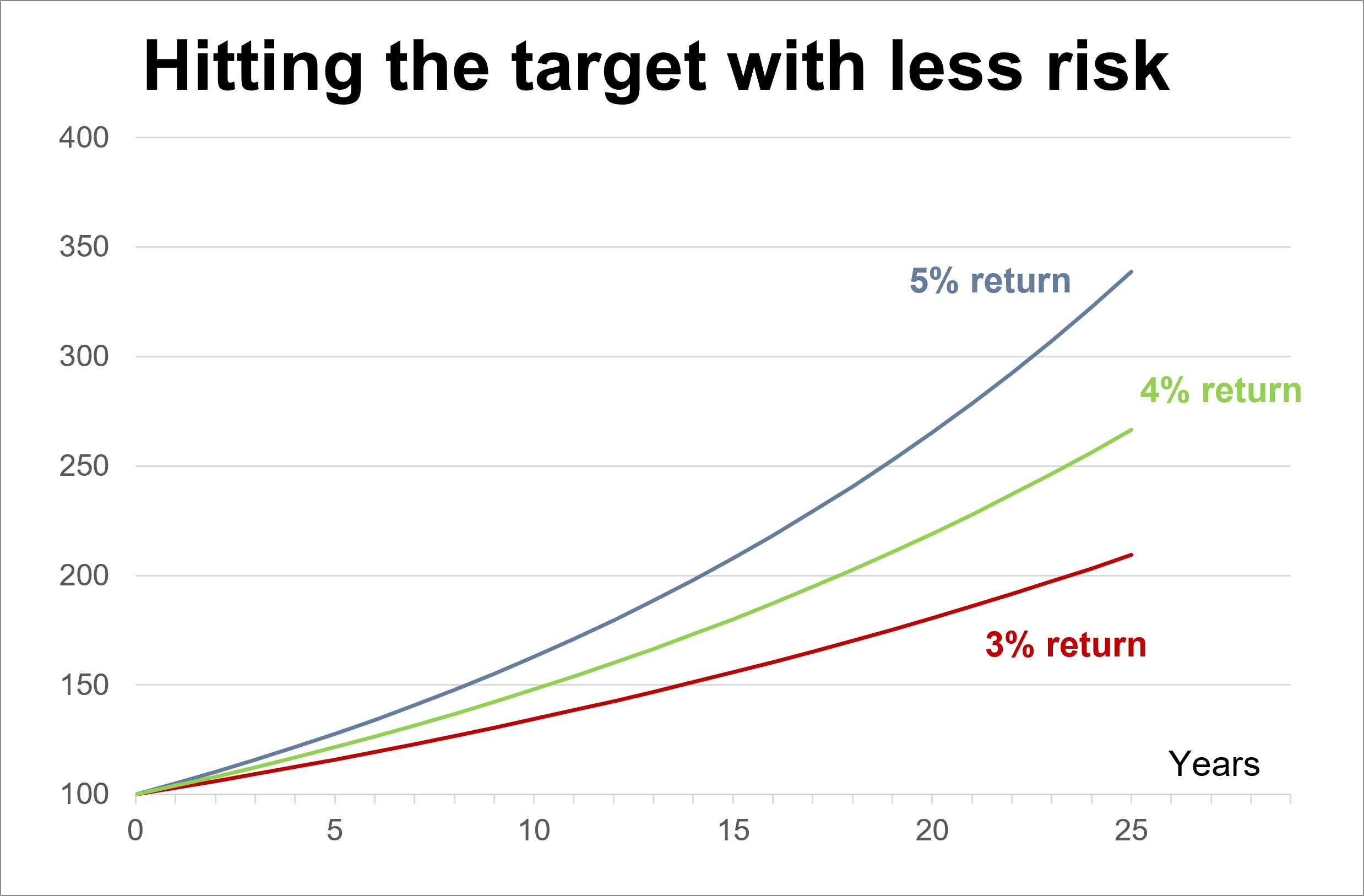
To illustrate, look at the chart below. Starting with $100, I have
mapped out three scenarios with average annual returns of 3%, 4% and 5%,
respectively. At a 3% return, the client reaches $125 (his 25% goal) just after
7 years. At 4%, he hits it in less than 6 years and at 5% he is there in 5
years. Assuming he lives to close to age 95, even the 3% scenario would have a
100% success rate.
And this income strategy would require a lot less of his portfolio
being invested in stocks. How much less? Well, if I assume equities deliver an
average annual return of 10% (and I will be generous in further postulating
that dividends are reinvested) and pick 3% as the average annual return on
fixed income (basically where GICs are today), then I can theoretically hit 5%
with only 30% in stocks. If I were satisfied with only 3.7% per year, then
based on historical returns, this could be done with only 10% invested in
stocks. In other words, less risk and less stress. In looking at the analysis,
he answered the question – “why am I taking this much risk?”
Now, you would be correct in pointing out that these returns are
pre-tax and, yes, this client is in the top marginal tax bracket. Well, if I
give him after-tax returns of 1.5%, 2% and 2.5%, the runway does have to be
longer, but not all the way to his expected life expectancy. For example, with
an after-tax return of just 1.5%, he reaches his 25% goal in 15 years and at
2.5%, he hits it before he turns 80. The key takeaway is that in each scenario,
he reaches his goal with less risk.
No growth objective at all
The other client is 98 years old and, when we sat down, his account
was 100% in equities. I asked him a simple question: had he promised a
beneficiary that he would double the money? “Are you crazy?” he said. He hadn’t
promised anyone anything. He had no growth target, no one waiting on a number,
and no plan that required his portfolio to compound. He was invested that way
because he always had been. It had never occurred to him to ask why. No need
for projections or scenarios. Just a heart-to-heart about the need for risk.
Asking the question
Neither of these clients was doing anything foolish. One had a growth
goal that didn’t require growth risk, and the other had no growth goal at all.
Both came out of the conversation with the why straightened out, from there the
what, when and where became much easier.
A few questions are worth putting to yourself, whatever your age:
- What is this money for?
- When will it be needed, and by whom?
- Is there a number it needs to reach, or a job it needs to keep doing?
- How would I feel, and what would I do, if it fell 20%?
- Does the way it’s invested still match the answers to the first four questions?
If the answers have changed, the portfolio may need to as well. That isn’t a
call to get more conservative, and age alone doesn’t decide it. Some objectives
genuinely call for a growth strategy. The point is simple: strategy should
follow purpose, not habit. When the “why” is clear, the rest of the investment
conversation becomes much easier.
On behalf of the Pyle Wealth Advisory team, have a wonderful weekend.
Andrew Pyle
Related posts
Andrew Pyle
July 17, 2026
Is this as good as it gets?
Banks have gone from safe haven to standout performer, but these elevated price levels can make the path forward less forgiving.
Read moreAndrew Pyle
March 22, 2024
History is not a guarantee of the future, but it can be a guide
History can provide some clues for the direction that economies and markets will take. Some are looking at the tech boom/bust for exactly that these days.
Read more