




Andrew Pyle
September 18, 2026


It Could Have Been Warsh
Last Friday, I was driving back from meetings in Toronto when my right front tire went flat as I merged onto the 407. I called the manufacturer’s roadside assistance line, and they cheerfully informed me it would cost $350 to tow me back to Peterborough and that I would have to wait four hours for the tow. Four hours on the shoulder of the 407 on a hot Friday afternoon? I don’t think so, so I called CAA. They had someone to me in 45 minutes, and the tow back to Peterborough didn't cost me a dime. The gentleman who showed up — a recent immigrant from Iran — was kind and courteous. Looking back on it as I sat in my driveway instead of a ditch, it could have been a lot worse. That phrase pretty much summed up markets this week too.
The Meeting Everyone Saw Coming
On Wednesday afternoon, the Federal Reserve’s FOMC voted 12-0 to raise the federal funds rate by a quarter point, to a range of 3.75%–4.00%. It's the first hike since July 2023, and it ends the “pause” that's been in place since the Fed's last cut back in December 2025. I emphasize the word “pause” since the next move after last December was supposed to be another cut, remember.
While there was an outside chance that the Fed would sit tight this week, mainly because the guy who gave Chair Kevin Warsh the job thinks interest rates should be below 1%, nobody should have been caught off guard. Warsh spent the weeks following his Jackson Hole speech in August telling anyone who would listen that the Fed still had "work to do" on inflation, and futures markets had this priced at well over 90% odds going into the decision. The statement leaned into that message: the economy is expanding at a solid pace, productivity is strong, job gains are keeping up with the workforce — the kind of language a central bank uses when it wants you to know a hike isn't an emergency brake; it's a tune-up.
Warsh went a step further in his press conference, framing the hike as good news for ordinary households — people without a stock portfolio or built-up home equity — arguing that price stability protects their paychecks more than a low policy rate does. Whether or not you buy the framing, the language was clearly aimed at trying to build inflation-fighting credibility in real time, in front of markets that have spent months questioning whether he has any.
The Part That Could Have Been Worse
Here's where the flat tire comparison actually earns its keep. Going into this meeting, the bond market was in a genuinely ugly mood. The 10-year Treasury yield pushed above 5% earlier this week for the first time since 2007. At the same time, the 30-year has been flirting with multi-decade highs above 5.3% and traders were concerned that, if the FOMC didn’t restore some credibility, the yield could easily rise to 5.5%, as you can see in the chart below. Some of that is the escalation in energy prices and geopolitical premium tied to the U.S.-Israel-Iran conflict that's been running since February, while some is linked to a federal debt load north of $40 trillion that bond buyers are increasingly unwilling to finance for free. The straw that could break the camel’s back would be a collapse in Fed credibility.
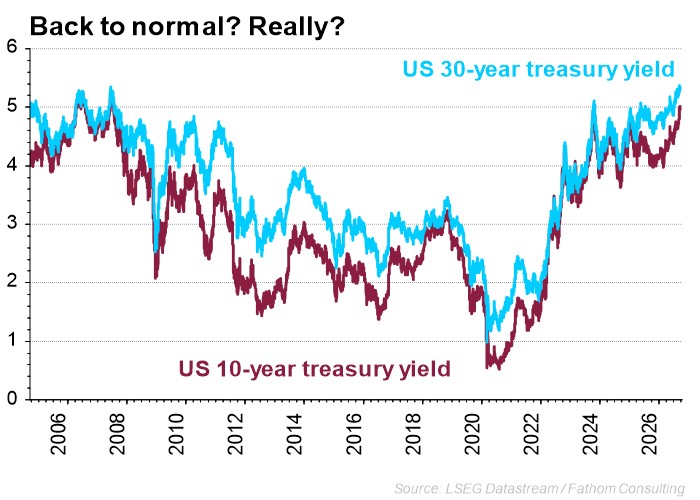
Given all that tension, a hike could easily have been the spark that sent long yields somewhere genuinely uncomfortable. Instead, yields actually eased after the announcement — the 10-year slipped about 5 basis points to roughly 4.95%. Equities took it in stride too: the S&P and Nasdaq both closed higher, the Dow essentially flat. That's the "tow truck was free and showed up in 45 minutes" outcome. It could have gone the other way. While it might sound counterintuitive to some, the decision to raise rates this week was good for bonds because it was a step in the right direction in terms of restoring credibility. Notice that I said “step”.
Where This Still Gets Bumpy
I don't want to oversell the relief. A single quarter-point hike doesn't repair a yield curve that's been under this much pressure, and the road ahead has real potholes. The dot plot and market pricing both point to more tightening to come — something in the neighbourhood of 100 basis points over the next year, based on futures pricing, though there's real disagreement about the path. Some strategists think the Fed ultimately delivers less total tightening than that (closer to 75 basis points) but front-loads it faster before year-end.
While Warsh provided some guidance in the press conference that the Fed would remain vigilant in its fight against inflation, and markets have priced in a few more hikes before this tightening cycle is done, the reality is that midterm elections are just weeks away. The US central bank typically does not like moving the policy needle right before a mid-term or presidential election, so getting another hike in October is unlikely in my opinion. Bond traders might give it a pass, but as I’ve been saying for a while, the inflation pipeline is filling up due to fuel prices being passed along to end users. Considering that the distractor-in-chief is publicly pressuring the Fed to cut rates, if we saw a traditional pre-election pause in October, it could turn out to be a credibility jab. If that’s the case, then where the policy rate is or goes matters less than what happens to longer-dated bond yields.
The policy rate and the long bond aren't the same conversation anymore. Mortgage rates are already showing it: the average 30-year mortgage rate is sitting at 7.19%, and the Mortgage Bankers Association's own economist is pencilling in two more hikes over the next year with mortgage rates remaining around current elevated levels regardless. If the Fed hikes and the long end doesn't cooperate, households and businesses financing anything long-dated — mortgages, corporate debt, government debt itself — keep paying the "elevated yield" tax whether or not the Fed thinks it's won. And this week may have provided an initial clue as to what to expect. August building permits fell by 2.7% from July and housing starts were down 2.6%. Other housing metrics are more mixed, but if mortgage rates remain elevated, then the outlook isn’t positive.
The Takeaway
This week's Fed decision was the equivalent of the tow truck showing up fast and free: a genuinely good outcome, delivered by someone (Warsh, CAA, take your pick) doing their job well under pressure. My tire was replaced, but I have a sour taste in my mouth for the vehicle, the company and the dealer. Similarly, the US bond market got a repair job this week, but do investors still like the brand? The other important thing to note is that rising bond yields aren’t just a US phenomenon. Most other developed countries have been experiencing the same thing, and other central banks are having to step up to adjust their policy rates higher to ward off inflation. Borrowing is also rising around the world as governments implement policies aimed at reinforcing defence and offsetting the damaging effects of Trump’s tariff tirade.
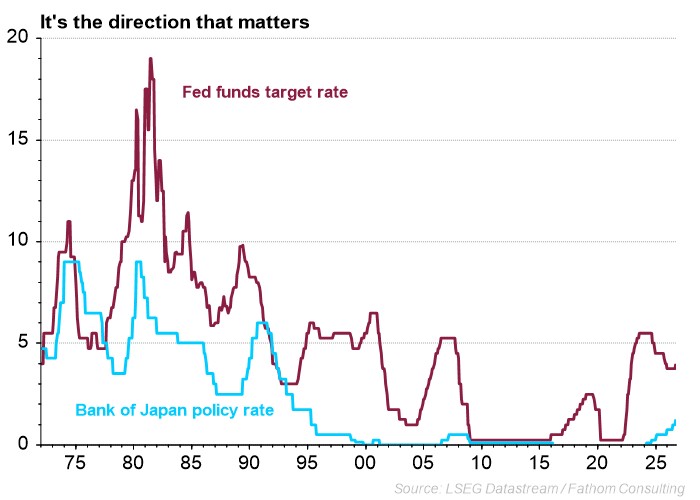
I found it almost laughable this week to hear that US Treasury Secretary Bessent had apparently “schooled” the Japanese Finance Minister on the need to rein in fiscal spending in order to bring bond yields down. The inherent risk in rising Japanese bond yields rising is that capital could shift from US treasuries to Japanese bonds – something that wouldn’t be palatable in the oval office. As I finish this week’s commentary, the Bank of Japan had just raised its policy rate by a quarter of a percent to a whopping 1.25%, as you can see in the above chart. This is the highest policy rate in 31 years and speaks to how a geopolitical policy decision has taken us from a declining rate and yield environment to a rising one. And it will have real economic effects – some that we are witnessing and some that have yet to emerge.
Are we at a juncture for the economic outlook in North America, abroad, and across financial markets? Possibly. But I want to end with an anecdote and a reference to the title of this missive. First, that gentleman that hoisted my car and brought me back to Peterborough had to sleep in his truck in another Ontario town because it was not economical to drive back to the GTA given the price of diesel. Yes, that’s the tip of the iceberg. As for the Fed, I do believe that the fact that we had a unanimous vote in favour of a rate hike this week was the FOMC supporting the new chair on a critical decision. Even the other Trump “leaners” fell in line. So yes, it could have been worse had it not been for Warsh.
On behalf of the Pyle Wealth Advisory team, have a wonderful weekend.
Andrew Pyle
Related posts
Andrew Pyle
July 03, 2026
There and back again
Markets in the first half of 2026 felt like a tough climb—steady gains, sharp descents, and unexpected turns. The ride mattered more than the distance covered.
Read moreAndrew Pyle
September 11, 2026
Progressive Overload
Plate by plate, the strain has been building in fuel markets, and now marine fuel may be next under the bar.
Read more