




Andrew Pyle
September 11, 2026


Progressive Overload
I've been adding weight to the bar at the gym lately and, at age 63, I am happy to be deadlifting more now than I ever have. Some of that's deliberate. Some of it isn’t. Stef has a habit of loading an extra plate on when I'm not looking, so I'll go to pull and discover the bar is heavier than I planned for. Either way, you don't always notice the exact moment when a lift stops being easy — you just look down one day and realize you're carrying a lot more than you were a few months ago. When I walk over to grab my water, panting, she will tell me that this is just progressive overload. Keep adding plates until you can’t do six reps, plateau, and then overload again. There is, of course, a limit to this. It’s just that I don’t know where it is…yet.
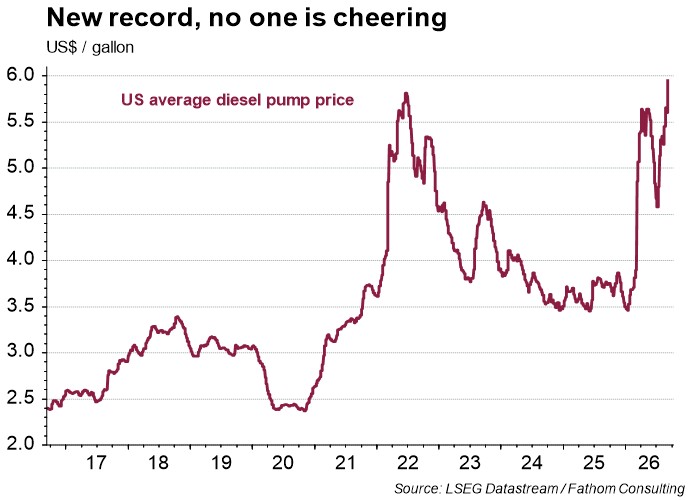
Global fuel markets have been going through their own progressive overload recently. This week, diesel prices in the US hit new record highs, but it’s not like we woke up one morning and saw this. There has been plate after plate loaded onto the diesel bar since early this year. How did we get here? No single event — more of a pile-up. Refineries in the Middle East took damage during the Iran conflict. Russian refineries have been repeatedly hit by drone strikes. And underneath both of those, the world was already short on refining capacity going in: plants that shut down for good during COVID and were never rebuilt, along with years of not building new ones. So even with U.S. refiners running flat out, the world still can't make diesel fast enough.
Refiners buy crude oil and turn it into things like diesel, gasoline, and jet fuel. The gap between what they pay for the crude and what they can sell the diesel for is called the “crack spread” — basically, their profit margin on turning oil into fuel. That margin has been running close to $100 a barrel this year, against crude prices around $85. Normally it sits well under $20. When that margin gets three or four times bigger than usual, it's not because refiners suddenly got greedy — it's because the world doesn't have enough capacity to turn crude into diesel fast enough to meet demand. Somewhere between 7 and 8 million barrels a day of global refining capacity is currently sitting offline. So even though there's crude available, there aren't enough working refineries to process it into the diesel people actually need. The price does the rationing instead.
And now the bar is threatening to bend somewhere else entirely: marine fuel, the stuff that moves your holiday packages across an ocean before a courier ever touches them. To understand why marine fuel is next, we not only need to understand the forces that have driven diesel prices so high, but how that very development has a feedback loop back to marine.
Then Refiners Started Choosing
Here's where the vicious cycle kicks in. Diesel is now so profitable to make that refiners have every incentive to squeeze out as much of it as they can from every barrel of crude — even if that means making less of something else, like marine fuel. The result: Energy Aspects projects a marine fuel shortfall of about 218,000 barrels a day this quarter — the first shortage of its kind since 2025, when the gap was a rounding error at 6,000 barrels a day.
You can already see it in prices. VLSFO — the low-sulfur marine fuel most large ships now burn — is trading above $800 a metric ton in major Asian bunkering hubs, and the spread between VLSFO and marine gasoil (a lighter, diesel-like marine fuel) has widened sharply, another sign that distillate demand is pulling supply away from the heavier fuel.
In other words: the same shortage that made diesel expensive is now showing up one product over, for the same underlying reason — there isn't enough refining capacity to make everything the world needs at once, so the market is prioritizing whatever pays best. Right now, that's diesel. And that means marine fuel — and the cost of shipping everything that moves across an ocean — is next in line to feel it.
Where This Shows Up in Your Shopping Cart
This is the part that matters beyond the energy pages — because the timing could hardly be worse. Ocean freight and trucking are about to head into their busiest stretch of the year. Peak holiday shipping season typically runs from mid-November through late December, but long before the shelves are filled, cargo ships need to get product into the wholesale supply chain, which means ships and trucks are running at full tilt now. If marine fuel keeps tightening the way diesel already has, that's a second major transportation cost rising at the same time as the first.
And the first one is already showing up in the numbers. The EIA is projecting on-highway diesel to average around $5.36 a gallon this quarter — roughly 50% higher than a year ago. One online source (GasBuddy) reported that a handful of gas stations in California posted diesel prices of $9.9999/gallon. The follow-on comment was that pumps cannot show prices of $10 or more, however, it is important to note that the average price for diesel in California was $7.91 and that the national average was $5.98, as you can see in the chart below. Regardless, these historic prices are forcing many carriers to widen their fuel surcharges, and shippers like Amazon have already said their 2026 holiday delivery surcharges will run higher than last year's, peaking in the same Nov. 22–Dec. 26 window most retailers depend on most.
Now layer marine fuel on top of that. Most of what fills store shelves for the holidays crosses an ocean before a truck ever touches it. If bunker fuel prices keep climbing the way VLSFO already has in Asian ports, ocean carriers will pass that cost through the same way trucking companies have — via surcharges — and retailers will have a decision to make: absorb the cost, or pass it to the customer at checkout, right when the customer is doing the most buying of the year.
I said a few weeks back that this doesn't have to be a replay of 2022, when freight and fuel costs fed directly into the inflation numbers everyone remembers. I still don't think it's inevitable. But the ingredients are stacking up in a way that makes the comparison harder to wave off than it was even a month ago — diesel and marine fuel rising together, right as peak shipping season begins, is a more dangerous combination than diesel rising on its own. And, as we saw this week, the memories of 2022 are permeating through the minds of bond traders and not just shippers, wholesalers and retailers.
Where the Cycle Could Break
A vicious cycle isn't a law of physics — it's a set of conditions, and conditions change. A few ways this one could ease before it turns into a full repeat of 2022:
Demand destruction. This is the most likely off-ramp, and there's already early evidence of it. When fuel gets expensive enough, some shipping simply doesn't happen — truckers park trucks and turn down loads that aren't profitable at current diesel prices rather than eat the cost. That's not a hypothetical: it's close to how the last cycle actually ended. Diesel prices fell by roughly a third over six months in 2022–23, largely because a freight recession took hold — trucking volumes slowed enough that demand fell back in line with supply, rather than supply catching up to demand. If the same thing is quietly starting to happen in trucking now, it could take some of the pressure off before marine fuel gets fully squeezed.
A cooling-off in the Middle East. The fastest supply-side fix would be a real de-escalation that gets damaged Middle Eastern refining capacity and disrupted shipping lanes back to normal. That's not something markets can price with any confidence, but it remains the single biggest swing factor.
New capacity coming online. This is the slow lane. Refiners can shift some of their yield between diesel, jet fuel, and marine fuel, but not without limits — and most analysts don't expect the underlying capacity shortfall to meaningfully ease before 2028.
None of these are things you can bank on. But they're worth holding alongside the “this could get worse” case — because the last time diesel prices looked this unsustainable, the market found its own way to bring them down, just not painlessly.
Back to Shopping
Finally, let’s bring this back to retailers as I know many of you might be concerned about the health companies on both sides of the border heading into the upcoming holiday season. For now, let’s set tariffs aside, though they may soon become impossible to discount or ignore if the Canada-US trade skirmish doesn’t get resolved soon.
Companies that are going to be most vulnerable to an energy / transportation cost shock are going to be those with the thinnest margins, like dollar stores. We have already seen Dollar Tree in the US shutting down close to 1,000 of its underperforming stores. Then there are those that serve a majority of their customers from exurban footprints and carry large inventories. This isn’t necessarily about the higher cost of bringing inventory into the stores, but how higher gasoline and diesel prices may cause customers to restrict trips to stores or consolidate their shopping among several big box stores (can I fit the fridge and the extra toilet paper in the car honey?). Finally, we have those companies with already high levels of leverage and less room to absorb cost increases. Oh, and on that point, interest rates are not moving in their favour either.
Thus, we come full circle to the demand destruction thesis. If this resurgence in energy prices, a return to tariffs, and rising borrow costs finally causes the North American (and global) consumer to blink, pause, or shrink, then that will be the likely solution to what is happening in the energy market. That would be a welcome outcome from the standpoint of getting prices down, but it wouldn’t be painless. Ally and I remain laser-focused on the fundamentals and where they ultimately point to, and we will make the necessary adjustments as things develop. As for me, it’s back to the gym next week and I know that I don’t always get to choose when the plates come off the bar, but my body eventually forces the issue.
On behalf of the Pyle Wealth Advisory team, have a wonderful weekend.
Andrew Pyle
Related posts
Andrew Pyle
July 03, 2026
There and back again
Markets in the first half of 2026 felt like a tough climb—steady gains, sharp descents, and unexpected turns. The ride mattered more than the distance covered.
Read moreAndrew Pyle
July 10, 2026
Bait of Hormuz
If the tanker attacks were bait, markets so far have declined to bite. The real test comes if conflict shifts from shipping to oil infrastructure.
Read more