




Andrew Pyle
August 21, 2026


Who’s Actually in Tune with AI?
The other week, when I had hit a bit of a wall with my guitar practice, Ben reminded me that I hadn’t started this journey with a deadline or a stopwatch, and gave me a simple song to reset: Audioslave’s Doesn’t Remind Me. Some of you won’t know it, but essentially it is built on repetition and avoidance — two chords, one groove, going around and around without resolving. Felt like I was playing something related to AI, but then after a little confidence boost, I went back to another friendlier song, and that was Blue Rodeo’s Lost Together. A much better vibe, and definitely well suited to what has been happening on the trade front as Ottawa and the provinces try to reach an agreement that serves as a pacifier for the disruptor-in-chief.
But the AI theme kept coming back and as I strummed and listened to the lyrics, I went back to a thesis that I discussed months ago. The world really isn’t “lost together” at all when it comes to the adoption of AI. There are countries that are completely in step with it, including China, Indonesia, Singapore, and Thailand. Others, Canada included, are markedly out of tune. Observing which populations believe in this technology maps well onto how an economy is built.
Ipsos runs an annual 30-country AI Monitor, and buried in this year’s edition is a simple question: do you think AI products and services have more benefits than drawbacks? Globally, 56% say yes. But the range around that average is enormous, and it isn’t random. Indonesia comes in at 85%. Thailand at 78%. Singapore at 73%. Mexico and Malaysia both around 70%. Meanwhile the United States sits at 42%, France and Belgium at 41%, and Canada — my own backyard — brings up the rear at 40%. Note that China is not covered in the Ipsos survey, however, other studies have shown high AI acceptance in the country. For example, the 2025 Edelman Trust Barometer Flash Poll covered only five countries but indicated an 87% acceptance rate in China versus 32% in the US. That’s not a small gap. That’s a nation where a majority of people are skeptical that AI does more good than harm, sitting next to nations where a strong majority believes the opposite.
My working theory has been that this isn’t about culture or optimism in some vague sense — it’s about how an economy is actually built. Specifically, I wanted to test whether AI acceptance tracks with how consumption-heavy versus investment/export-heavy an economy is. The idea being that if your economy runs on household spending, AI shows up mostly as a threat — to your job, to your favourite call centre, to the guy who writes ad copy for a living. If your economy runs more on investment and exports, AI shows up mostly as an opportunity — new factories, new supply chains, new things to build and sell.
So, I pulled household consumption as a share of GDP for the same countries. The World Bank’s 2024 data give us a clean cross-section, and the pattern holds up better than I expected:
• Singapore: household consumption is just 31% of GDP — one of the lowest ratios anywhere in the world, dominated instead by trade and investment flows. AI acceptance: 73%.
• Indonesia: consumption at 55% of GDP; a young, export-oriented, manufacturing-adjacent economy. AI acceptance: 85%, the highest reading in the entire survey.
• Thailand: consumption at 58% of GDP. AI acceptance: 78%.
• United States: consumption at a hefty 68% of GDP — the most consumption-dependent large economy on earth. AI acceptance: 42%, near the bottom of the table.
• United Kingdom: consumption at 61% of GDP. AI acceptance: 43%.
• Canada: consumption at 56% of GDP — actually lower than Mexico’s — yet AI acceptance is the lowest of all 30 countries surveyed, at 40%.
The scatter chart below shows the differences graphically. What is readily apparent is that there is no real inverse relationship between how consumption-dominant a country is and its population’s warm and fuzzies about AI. There are definitely a few that support the view, but what is much more apparent is that this is more a regional phenomenon than one driven by economic structure.
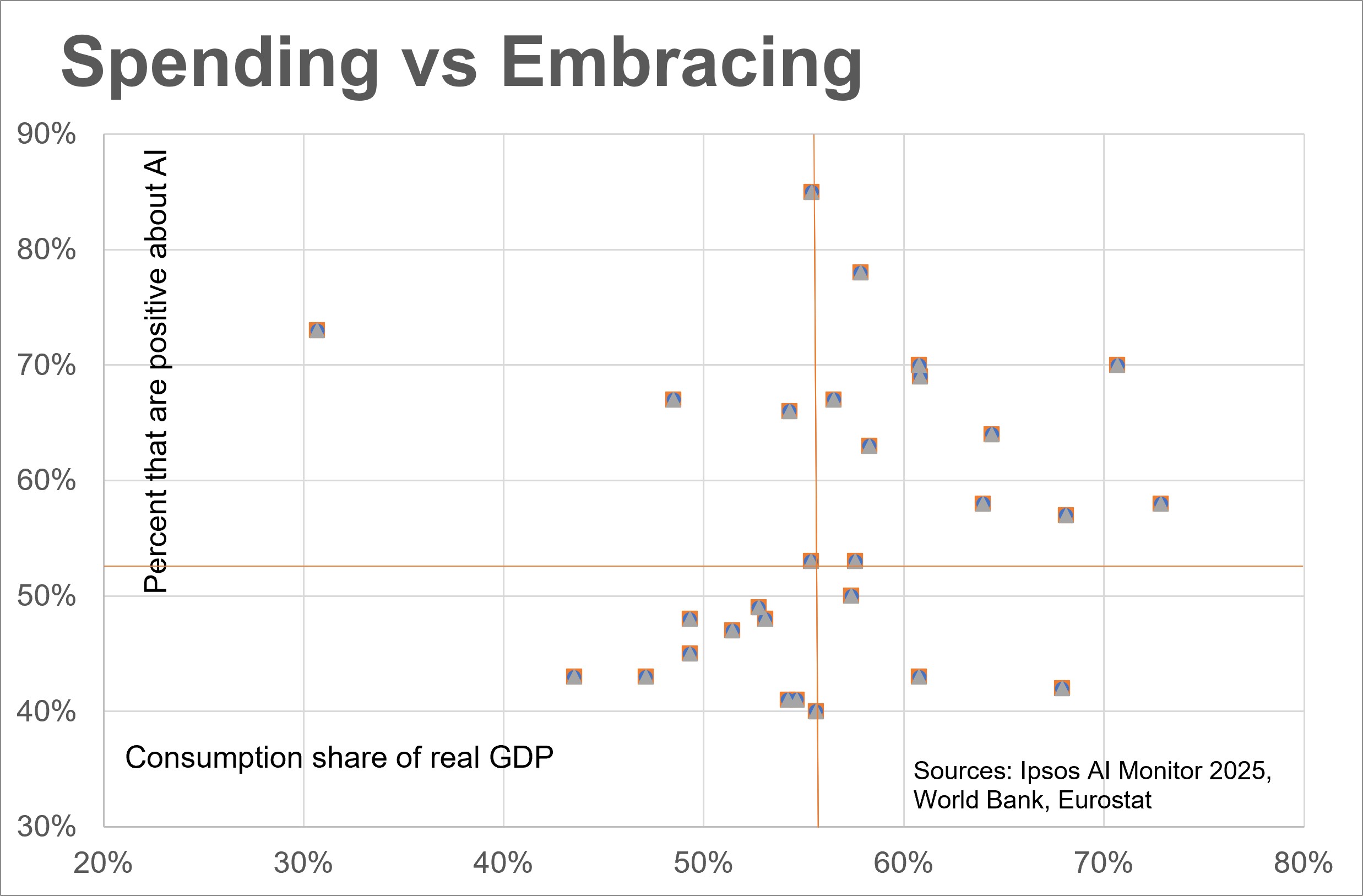
Of the five countries with an AI acceptance score of 70% or higher, four of them are in Southeast Asia. More to the point, they are all emerging economies, with the exception of Singapore. If I extend it to countries with an acceptance rate of 60% or higher, there are 11, and with the exception of South Korea, they are all emerging (though many consider South Korea to still be “emerging”). Conversely, if I look at the 12 countries with acceptance below 50%, all are developed (with the exception of Hungary). For the record, Canada had the lowest acceptance rate at 40%.
But the broad pattern is hard to ignore. The U.S., U.K., Canada, and Australia — all consumption-heavy, all post-industrial service economies — cluster at the bottom of AI acceptance. Indonesia, Thailand, Singapore, Malaysia — all more tilted toward investment, manufacturing, and net exports — cluster at the top. Ipsos’s own researchers noted that the countries most excited about AI tend to be the ones that think it will benefit their national economy, not just their personal convenience. That’s consistent with what I’m describing: in a consumption economy, AI is competing with you for your job and your relevance. In an investment/export economy, AI is a tool you use to build the next factory or win the next contract.
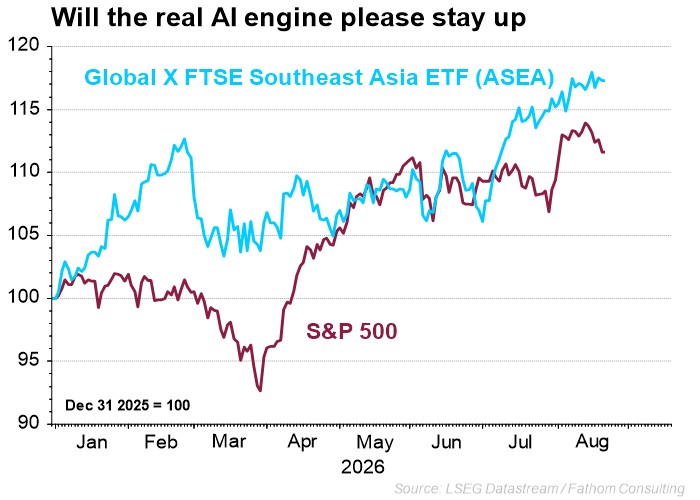
If these patterns hold, it could have real implications for how we think about AI-adjacent equities and currencies. The economies most structurally inclined to embrace and deploy AI productively aren’t necessarily the ones building the models — they may be the ones positioned to absorb the technology fastest into export-facing industries without the same domestic backlash we’re seeing take root in North America and parts of Europe.
The central theme last year was one of de-dollarization and how flows of capital away from the US to other regions could support outperformance by the stock markets in those regions’ vis-à-vis the US and how this could potentially lead to a trend depreciation in the US dollar. The above chart shows the S&P500 index versus the GlobalX FTSE Southeast Asia ETF (ASEA) since the start of the year. Not only did this region hold up better during the initial fallout from the Iran war, but it is also outperforming by about six percentage points so far. The AI adoption observations could lead to another shift in flows beneath the surface that might favour Asia and emerging markets. It is premature to weigh in definitively, but the AI chords appear to be more in tune in some countries than others and investors will be forced to listen for the differences.
On behalf of the Pyle Wealth Advisory team, have a wonderful weekend.
Andrew Pyle
- Boston Consulting Group, “Consumer Spending Is Up, But That Signal No Longer Means What It Once Did” (https://www.bcg.com/publications/2026/canadas-consumer-spending-is-up
Related posts
Andrew Pyle
September 11, 2026
Progressive Overload
Plate by plate, the strain has been building in fuel markets, and now marine fuel may be next under the bar.
Read moreAndrew Pyle
October 16, 2026
Lost at C
AI may be taking the lead guitar part, but consumer spending is still carrying the song—and its footing looks increasingly shaky.
Read more