




Andrew Pyle
September 26, 2025


EVerything is critical
In markets, acronyms often define eras. From FAANG to BRICs, they become shorthand for sometimes seismic shifts. Today, another pairing dominates headlines: EVs and critical minerals. The former – electric vehicles – are not just cars with plugs; they represent a cultural and industrial transformation. The latter – minerals like lithium, cobalt, nickel, and rare earths – are the building blocks of this revolution. Together, they form what might be the most consequential marriage of technology and resources since oil and the internal combustion engine.
The clean energy theme has gone through a metamorphosis over the past five years, not only from a holistic climate change perspective but also in terms of its impact on public and private investment decisions and capital flows. When we came out of the pandemic, cash was abundant and global politics were generally in alignment toward slowing down climate change. This was also the period when you couldn’t help to trip over the acronym “ESG” in financial statements and investment products. It was all great until the first quarter of 2021, when the wheels came flying off. What ensued was a four-year storm, culminating with the inauguration of a climate change skeptic, which evaporated much of the progress made during the previous ten years. There are signs, however, that clean energy and electrification are staging a comeback. Even Trump wants to buy lithium!
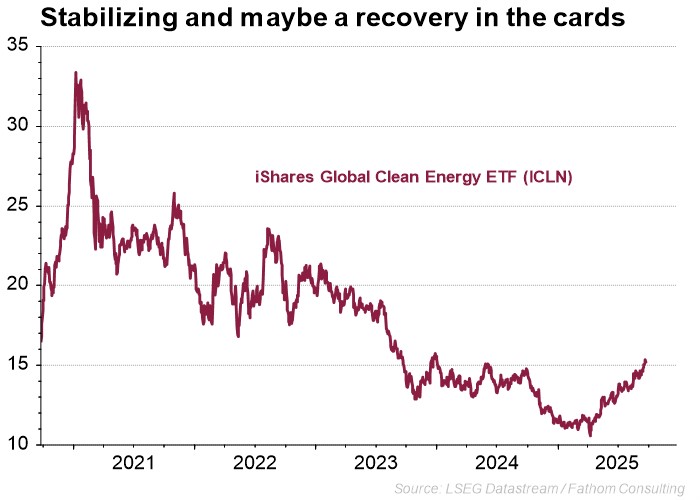
The above chart shows the iShares Global Clean Energy ETF (ICLN), which is a fairly close approximation of the performance of equity securities in this space over the past ten years. Again, you can see the rapid ascent during 2020 after the brief setback at the start of the pandemic and the subsequent retreat that lasted until the beginning of this year. Ignoring the knee-jerk response to Trump’s tariff tantrum in April, the ETF finally stabilized near levels seen toward the end of 2019, and the last several months have seen a respectable rebound.
According to the International Energy Agency’s Global EV Outlook 2025, sales of electric vehicles continue to surge, even if the growth curve is showing early signs of moderation. Bloomberg NEF projects a record year for global EV sales in 2025. Yet, beneath the celebratory headlines lies nuance: growth is not uniform, and the dependency on critical minerals introduces both risks and opportunities. Global EV adoption has moved from niche to mainstream. In Q1 2025, around four million EVs were sold worldwide, representing a 35% year-over-year increase. China accounted for more than 65% of those sales — over 11 million units — while Europe took roughly 24% and the U.S. about 10%. China’s dominance is not simply a function of scale; it reflects the effectiveness of subsidies, local supply chains, and aggressive automakers like BYD.
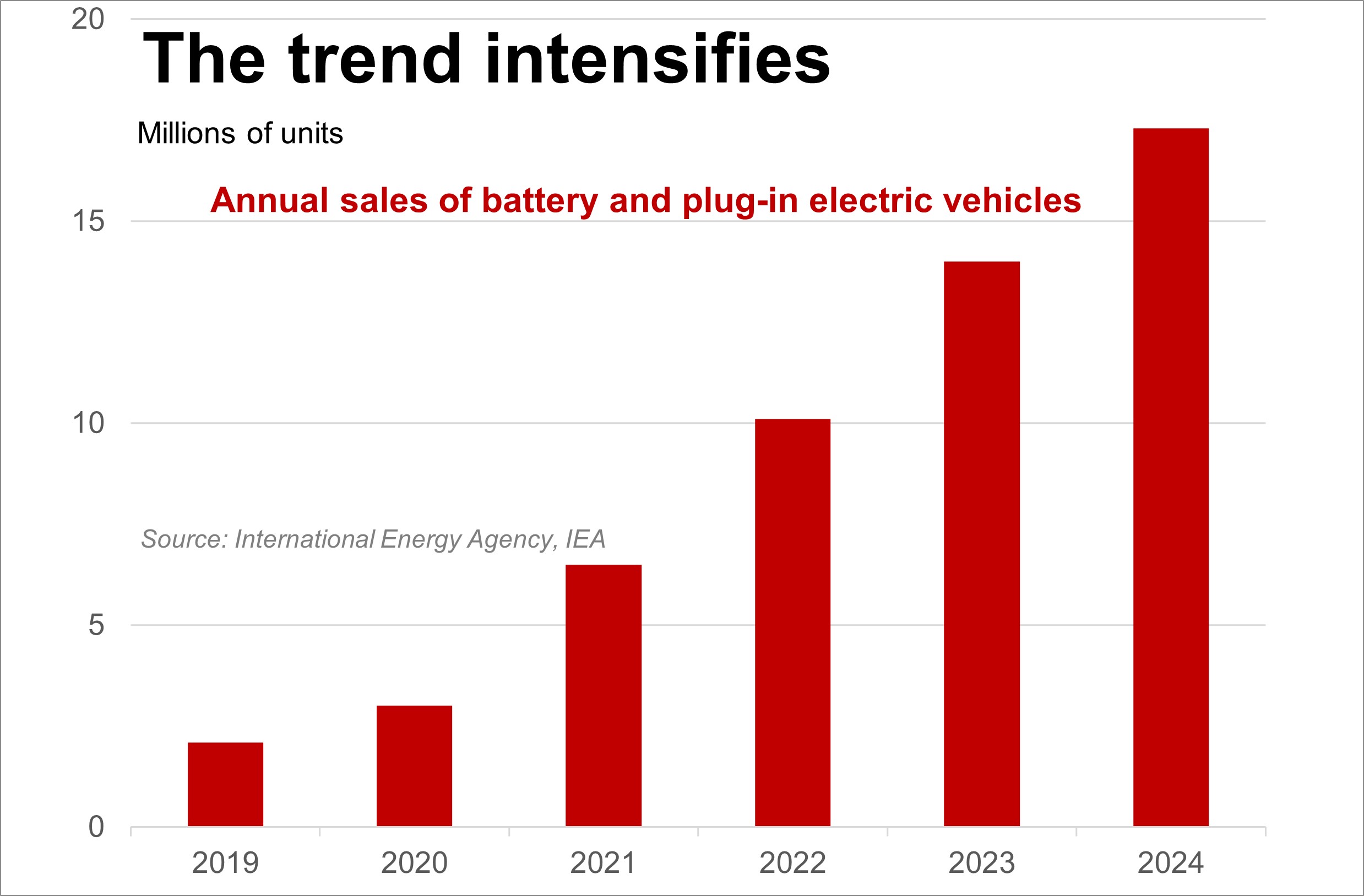
But the story isn’t uniformly rosy. U.S. battery electric vehicle sales actually fell 3% in Q2 2025 compared with Q2 2024 – the first quarterly year-over-year decline for that segment. July brought further deceleration, with global EV sales growth slipping to just 21% year-over-year, the slowest pace since January. Reuters flagged weakening demand for plug-in hybrids in China as a contributing factor.
Automakers are reacting in different ways. Tesla remains a symbol of the sector but is contending with a maturing market and intensifying competition. Traditional players like Ford and GM are navigating cost challenges, while European automakers face regulatory uncertainty.
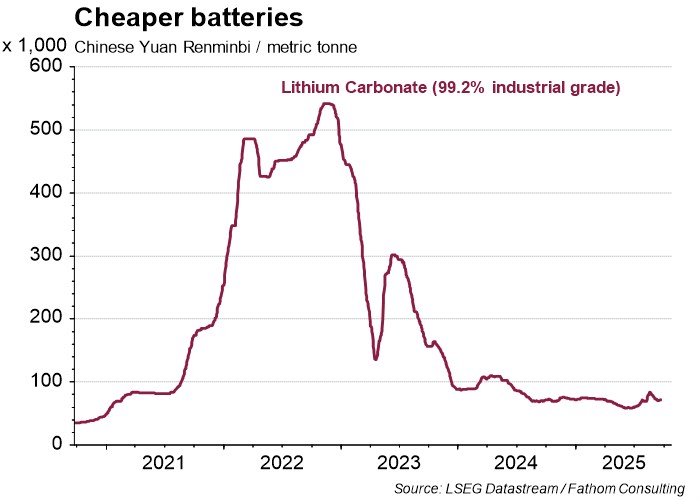
If EVs are the shiny consumer-facing story, critical minerals are the gritty industrial reality. Lithium, cobalt, nickel, and rare earths are to the 21st century what oil was to the 20th: enablers of growth, power, and geopolitics. Global demand for these minerals is expected to exceed 40 million tonnes annually by 2030, up from about 7 million tonnes in 2020. Lithium alone is forecast to see demand triple by 2030, while rare earth demand for magnets could rise by 400%. Yet supply chains remain fragile. Lithium prices – after soaring to record highs in 2022 – have corrected sharply as supply caught up.
Which brings us back to Trump. It’s notable how the federal government is taking 10% stakes in companies – almost like a high-level game of Monopoly. First, we had Intel (we will delve into that one on next week’s conference call), and now, this week, the Trump administration announced that it had proposed acquiring a 10% stake of Lithium Americas Corp (LAC) to support its Thacker Pass project in Nevada. That news sent the company’s stock soaring nearly 100% on an intraday basis on Wednesday.
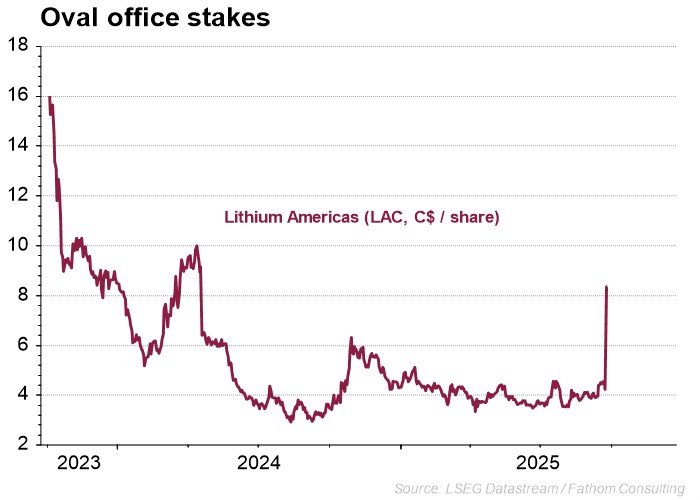
Now, a quick refresher on LAC. In 2023, the company was reorganized into two separate entities – LAC (U.S.) and LAAC (Argentina). GM currently has close to a 40% stake in LAC, which gave the automaker the right to purchase all of the first phase of production from Thacker Pass and 20 years of phase two. There was a $2.26 billion loan provided by the Department of Energy, interestingly approved in Trump 1.0 and cemented by Biden. GM believes that with the lithium it secures from Thacker Pass, it can produce 1.6 million EVs over 20 years. Perhaps, but there are a few observations from this.
With Tesla struggling to sell vehicles anywhere other than the White House driveway, the Chinese dominance in EV is even more stark. If trade talks between the U.S. and China were proceeding swimmingly, then there would be little to worry about in terms of lithium supply. Ukraine also has a significant supply of the critical mineral. What did we hear from Trump at the UN this week? More support? Finally, the U.S. Treasury Secretary announced a $20 billion currency swap line with Argentina this week and further stated Washington’s intent to buy Argentine dollar-denominated bonds. Where else can we find lithium? Well, look to the other half of Lithium Americas for that. Whether or not the Argentine swap arrangement is tied to gaining access to lithium, it is curious that these commitments are coming from an administration that states climate change is a hoax. The momentum in China’s ability to produce the hardware ingredients for its AI buildout has prompted the Oval Office to take a 10% stake in Intel, followed by a capital infusion from Nvidia and now a cap-in-hand request by Intel for cash from Apple.
The geopolitical layer is indeed interesting. China controls a large share of the global processing capacity for lithium and rare earths. In response, G7 nations are reportedly weighing price floors and potential taxes on Chinese rare earth exports to reduce dependency. Canada, meanwhile, finds itself in a strategic position. Ottawa has rebranded its critical minerals strategy away from solely climate goals toward resilience and sovereignty. Recent agreements with Germany underscore Canada’s potential as a “friendly supplier” of minerals to Western economies. The recent discussions about tariffs on Chinese EV exports into Europe and North America are reminders that geopolitical protectionism could reshape supply chains just as much as innovation. Canada could see an opportunity in relaxing tariffs on Chinese EV imports in exchange for reduced restrictions on Canadian agricultural exports to that country. Germany’s agreement with Canada on midstream processing highlights the pivot from extraction alone to building refining and processing capacity. This shift reflects a broader realization: control of the value chain is as important as access to raw materials.
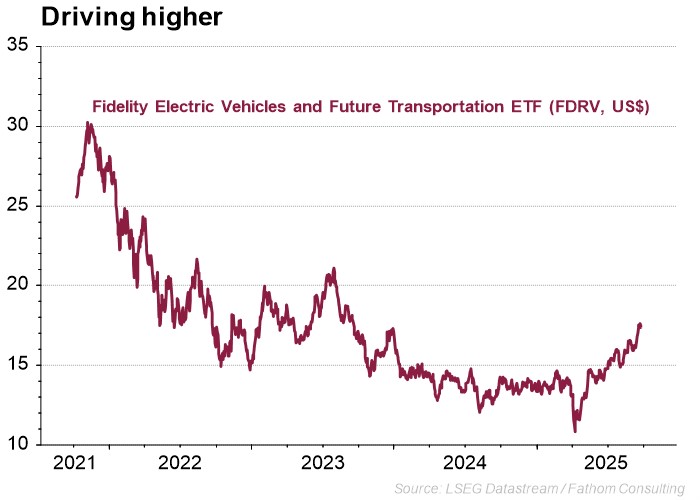
For investors, the EV and critical minerals story is compelling but complex, with not only numerous individual companies in various areas of the space, but also a proliferation of mutual funds and ETFs. The above chart illustrates just one – in this case, the Fidelity Electric Vehicles and Future Transportation ETF (FDRV). In a similar pattern to what we saw with the clean energy index, this ETF has now retraced more than a third of the ground lost since the peak in 2021.
ETFs focusing on lithium and battery technologies have mirrored commodity swings — euphoric rallies followed by sharp pullbacks. One lens is to treat EVs as a technology play, focusing on automakers, software, and charging infrastructure. Another is to approach the sector through commodities, where cycles of supply and demand dominate. For clients, the key is balance: gaining exposure to long-term secular growth while recognizing the short-term risks of overcapacity, subsidy dependence and geopolitical interference.
Canadian investors, in particular, may find opportunities in domestic mining equities, which benefit from both resource exposure and strategic partnerships. However, patience is required, as permitting bottlenecks and political shifts can delay project timelines. Global ETFs tied to battery technology and critical minerals also offer diversification, though volatility should be expected.
The clean energy transition is not a straight line. EV adoption continues to expand, but with slowing momentum in some regions. Critical minerals remain essential, but their markets are volatile and geopolitically fraught. For investors, this space offers both opportunity and risk. The long-term trend toward electrification and clean energy is undeniable, but navigating the path requires discernment. Clients should be prepared for volatility while keeping an eye on structural shifts that create lasting value. One thing is certain: this segment of the market won’t be EV-entless.
On behalf of the Pyle Wealth Advisory team, have a wonderful weekend.
Andrew Pyle
Related posts
Andrew Pyle
October 30, 2026
The Road Less Hiked
The road less hiked made all the difference this week, with the BoC opting to move while the Fed preferred to linger at the fork.
Read moreAndrew Pyle
October 23, 2026
Death and Taxes: Agonizing Over the Wrong Bill
The bill most families worry about after death is often not the one that costs the most. Good planning starts with knowing the difference.
Read more