




Andrew Pyle
September 19, 2025


The central focus
Nobody is perfect and everyone makes mistakes, including central bank officials. Then again, sometimes blame is placed on monetary policymakers even when it is not warranted. It was incorrect to take interest rates to extreme lows after the tech bubble and recession of the early 2000s. It caused an explosion in debt and increased dependency on below-average rates and yields, to the extent that even a modest tightening in policy by 2006 caused the ship to keel over. They cannot be blamed for doing the same thing in the midst of the pandemic, though some culpability can be laid on them for being a little too slow to tighten as inflation jumped in the wake of the pandemic.
This year, both the Bank of Canada and the Federal Reserve have conducted policy as best as one could expect, even in the face of external challenges. Here at home, Governor Tiff Macklem and crew were faced with a federal government leadership change and subsequent election, then had to stick-handle a toddler president and trade tantrums. The latter was also something Chair J Powell and the FOMC faced, but discord between the oval office and the Fed has represented yet another layer of noise and something the Bank didn’t have to deal with. After all, no one in Ottawa has called Macklem “slow”, a “numbskull”, and an “idiot”. Nor has anyone insisted on Macklem being fired or has actively pursued the firing of someone else on the Bank governing council. For these reasons and a shift in underlying economic conditions, market participants were laser focused on this week’s policy meetings.
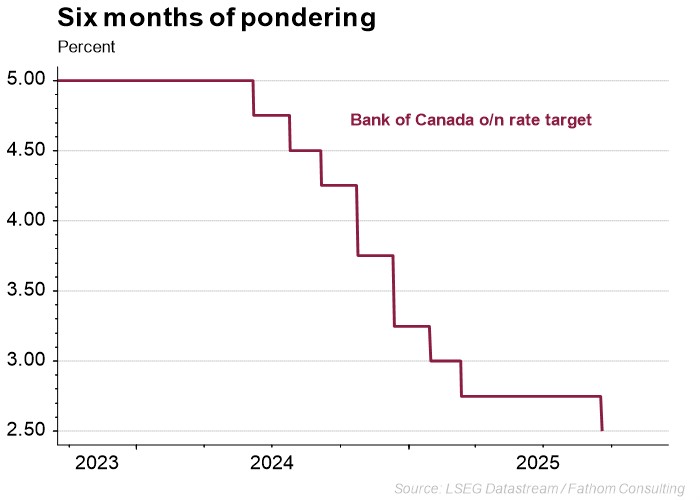
Let’s begin with the Bank of Canada. For the first time in six months, the Bank decided to cut its official overnight target rate a quarter point to 2.5% as you can see in the above chart. Considering the storm that Trump created in April, one might have thought that an easing in policy would have taken place at either or more of the April, June or July meetings but it didn’t. The Bank was actually very astute in recognizing that worst-case outcomes regarding tariffs were not materializing and that the economy was holding up just fine.
That changed this week, as the Bank recognized that global growth is slowing and cracks have been appearing in the U.S. economy. While Bank officials had predicted the contraction in Canadian economic output in the second quarter, this weakness has reverberated through to the labour market, as it cited the two months of employment declines since July and the rise in the unemployment rate to 7.1%. In addition, the Bank expects further weakness in employment conditions alongside slower population growth, which combined will put pressure on households.
With respect to prices, the Bank indicated that upward pressure on core inflation has dissipated and that the recent decision by the Carney government to walk back the majority of retaliatory tariffs on US goods will further take pressure off inflation. That said, it is also keenly aware of the potential effects from trade policy uncertainty south of the border, changing supply chains and the adaptability of businesses and consumers to these altered times. Long story short, there was enough supporting evidence to support a rate cut this week, but there is no commitment to a pattern of rate cuts. In other words, the Bank remains data dependent.
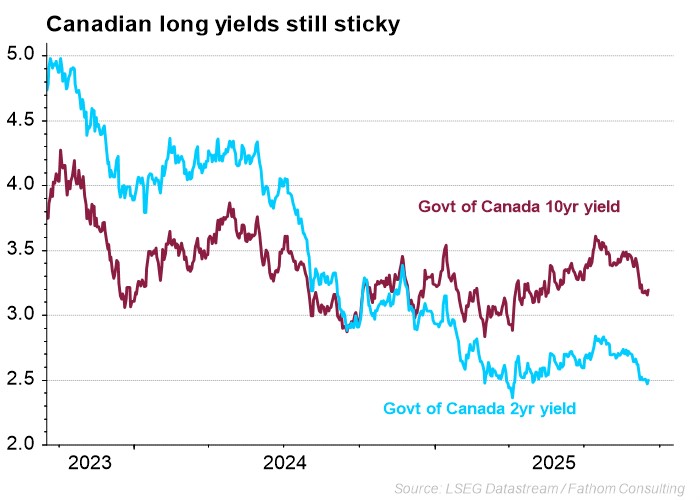
Expectations for a rate cut this week have been building for weeks on the back of key indicators, like employment, so there was little incremental movement in Canadian bond markets on the decision. As the chart above shows, yields had already fallen sharply from mid-July though even with this week’s rate decision, the 2-year government of Canada yield is still about a tenth of a point above the lows seen in April. As for the 10-year yield, we remain about a third of a percent above the lows from the Spring even after the rally since July. This stems from the non-cyclical factors impacting longer term bonds around the world, which we discussed a couple of weeks ago. And without more constructive news on inflation and/or fiscal matters, we are unlikely to see further progress on long yields.
And speaking of things that can be a potential impediment to the long end of the curve, I give you the state of U.S. monetary policy. As mentioned, all eyes were on the Fed this week – not just the decision on rates or even the statement, but how Powell would appear during the press conference. To begin with, market participants got what they expected – a quarter point cut in the Fed’s target range for the fed funds rate to 4-4.25%. As the chart below shows, this was also the first move in quite some time.
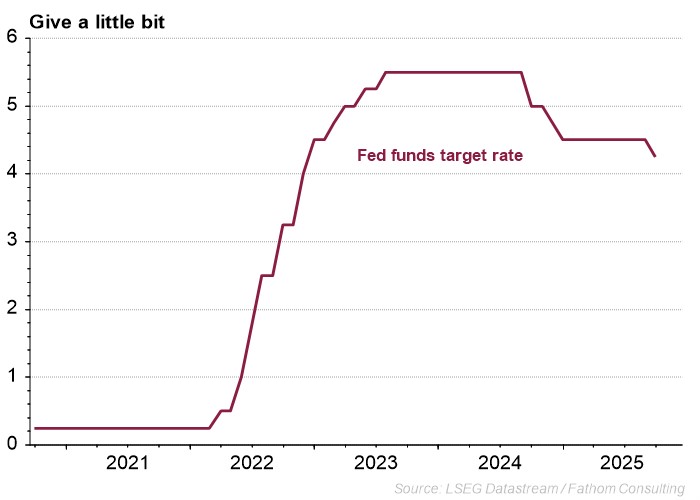
Forgetting the fact that Trump is attempting to orchestrate an end-run on the FOMC, by trying to get four hand-picked governors to the table (which would represent a majority of the 7-governor board), there has been enough empirical support for a resumption of rate cuts. In its statement, the Fed highlighted the moderation in economic activity in the first half of the year and the slowing of job gains (ok, how about an outright halt?) and indicated that “downside risks to employment have risen.”
Yet, that’s where the differences between this statement and the one from July 30th ended. Well, almost. FOMC officials have laid out zero plans for a patterned reduction in rates and effectively are in the same gear as the Bank of Canada – data dependent. There was however a difference in terms of dissenters to the decision. At the last meeting, where the FOMC voted in favour of keeping rates unchanged, two officials dissented and instead opted for a quarter point reduction (Bowman and Waller). Both of these may not be Trump leaning members, but they have been in the running to become chair. This time around, the only dissenter was someone who literally just confirmed as a member of the Fed board and that is Stephen Miran, who wanted a half of a percent cut in rates.
Now, Mr. Miran is currently on temporary leave from his position as the chair of the Council of Economic Advisors. In other words, he works for Trump and still does since he has not relinquished his role to become a Fed board member. This is the first time in the Fed’s history that a White House official has also been on the board. At the same time, Trump has been trying desperately to remove governor Cook from the board on alleged mortgage improprieties before she even joined. Two more “evacuations” and the majority of the board would be had. Fortunately for the Fed, Powell and even the markets, there were some wrinkles.
For one, the push to have Cook removed was not only thwarted by the court. Second, Bloomberg News discovered that Treasury Secretary Bessent also agreed to occupy two different homes as “principal residence” at the same time. Different circumstances, but also enough similarities that the double-standard wall might be too high for the Supreme Court to hurdle over. The other wrinkle came right out of the press conference when Powell didn’t push back against the notion that even if he were removed as Fed chair, he is legally able to remain on the board until his term is over in 2028. The majority is looking a little harder to obtain.
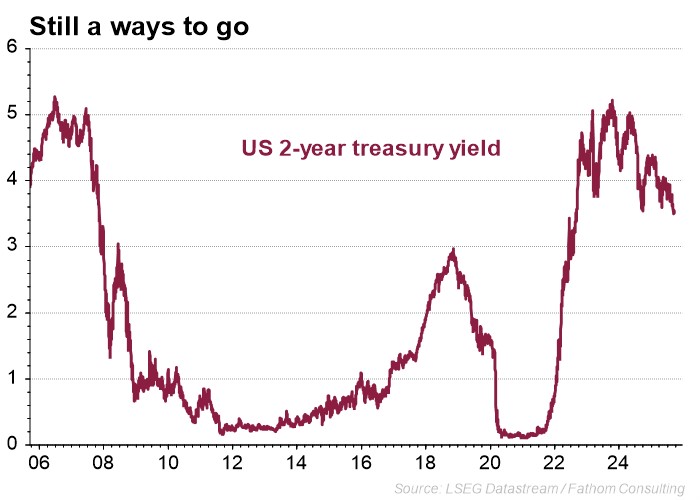
Let’s put this whole Fed affair in a market perspective. First, the decision to cut rates this week was fully baked in and the language in the statement and press conference neither refutes expectations of additional moves this year and into 2026, nor gives them a rubber stamp. If the economic fundamentals warrant, we probably will get at least one more cut before the end of the year and if the odds of two increase, then we might see the US 2-year treasury yield finally break sustainably below 3.5%, as seen in the chart above. That is why we continue to maintain a short duration lean in the bond portfolio.
Some have suggested that if the September jobs data capsizes, then a half-percent reduction in October might be in the cards. Perhaps, but is the stock market really going to remain pumped if the labour market is on the ropes, regardless of what the Fed does? Last month, the unemployment rate rose to 4.3%, and if it pushes past 4.5%, then we might enter a traditional scenario where it achieves escape velocity, so to speak, and the graph becomes a little more vertical. It has taken more than two years for the US unemployment to rise just under one percent. The next one percent could happen in less than half a year. If so, then larger rate cuts are likely.
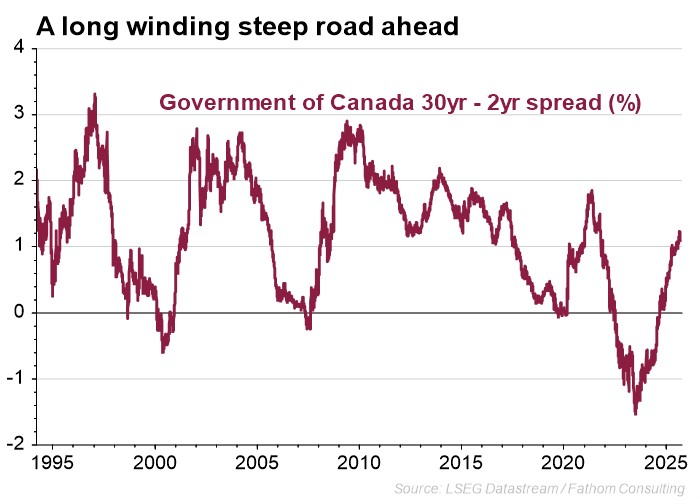
In that event, the yield curve will steepen, and this would also be echoed to some degree for Canadian bonds. In the above chart, we are looking at the spread between the Canadian government 30-year bond and 2-year bond, which is currently around 1.1%. Let’s assume that both central banks lower rates an additional quarter to half of a percent in the coming months. Furthermore, let’s assume that the international investment community remains suspect of longer-term inflation and deficit control. This could allow for a further steepening or widening in this spread. Keep in mind that we are around a third of the peak spread seen in 1997 and much less than half of that in 2009.
If we are going to see further steepening of the curve, what does mean for our equity positioning? On both sides of the border, we would expect that banks and diversified financials would do well on a relative basis with a steepening yield curve. Since banks lend out at rates higher than what they pay on deposits (net interest margin, or NIM) then outside of a significant hit to the economy, this should support bank valuations. The same holds true for insurance companies, as well as some energy and material groups. That said, banks have been on more of a tear of late than insurance so it might be worthwhile looking at a potential rotation. Utilities, another interest-sensitive segment of the market, has seen a modest fade over the past four weeks, but could be a better defensive play into Q4.
It currently looks like the grandiose schemes that pundits felt Trump had up his sleeve have been put back on the shelf, for now at least. Think of a Fed takeover, forced rate cuts and Treasury manipulation over what bonds get issued and possibly bought back on to the Fed’s balance sheet. It is entirely possible that investors feel more comfortable allocating capital to the long end, which means the curve flattens. We have modest exposure there but will be ready to shift to heavier weightings if it makes sense.
A steady hand is a key assumption of monetary policymakers and this week showed that we can breathe a little better that this assumption remains intact. As we know, things get a little turbulent when someone doesn’t get their way, so who knows what curve balls are coming when the UK tour is over.
On behalf of the Pyle Wealth Advisory team, have a wonderful weekend.
Andrew Pyle
Related posts
Andrew Pyle
October 30, 2026
The Road Less Hiked
The road less hiked made all the difference this week, with the BoC opting to move while the Fed preferred to linger at the fork.
Read moreAndrew Pyle
October 23, 2026
Death and Taxes: Agonizing Over the Wrong Bill
The bill most families worry about after death is often not the one that costs the most. Good planning starts with knowing the difference.
Read more