




Andrew Pyle
September 05, 2025


The 30-year reckoning
Picture this. It is August 15th, 2055. The sun is shining with temperatures set to hit 40 – hotter than the previous record more than 100 years ago! You have been eagerly awaiting this day, because your advisor told you that the 30-year U.S. treasury bond you bought back in August 2025 is coming due. Finally, the $100 face value you paid for that piece of paper is going to be repaid back into your account. For one, you are simply glad that the American government remained solvent enough to pay you, but you are also happy that this long and wild investment ride was over. You even vaguely remember someone named Ally Pyle commenting on a business show that August of 2025, saying how folks should be staying mainly short to medium term in their bond portfolios.
Now, let’s come back to the present. That bond, which was issued last month, carries a 4.75% coupon - almost three quarters of a percent higher than the 30yr bond that came to market this time last year. Over the past two years, the 30yr yield has traded roughly in a 4-5% range and that is something we haven’t seen since 2009-2011. As we have discussed before, this higher yield environment is something that is showing up around the world. The chart below shows the 30yr benchmark yields for the U.S., Canada, the UK and Japan. Of this group, Canada is the only country not to have seen its long bond return to the high in early 2023.
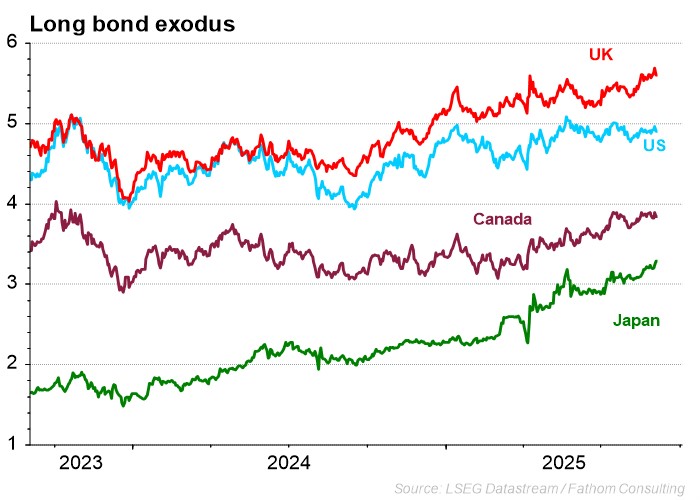
There are two main reasons behind the sell-off in long-term bonds which can be applied to most regions. That would be persistently high inflation and inflation expectations, and a deteriorating fiscal climate, where countries are spending vast sums on defense, infrastructure and economic incentives to counter the negative economic shock that is Trump. The inflation concern is exacerbated by the prospect of continued easing in central bank rates at a time when there is still relatively decent demand. With Trump threatening the independence of the Federal Reserve by attempting to get hand-picked Governors on the board (to achieve a 4 out of 7 majority), fixed income investors are demanding an even larger risk premium, also known as the term premium.
In its commentary this week, BlackRock noted that the 30-year U.S. yield has risen even as 2-year yields softened, highlighting an increase in term premium at the long end. This has steepened the yield curve to 1.3% (the difference between the 30-year yield and the 2-year yield), which is almost double the spread this time last year.
Now, you might ask why investors would demand a larger premium to buy a long-term bond today than last year? Yes, there is usually going to be some additional premium needed, since you are giving the government your money for a longer period of time (let’s forget periods where the yield curve inverts, for now). Back to my futuristic opening, the individual does get their original investment back, which is $100 – or the price the bond was issued at. Sort of, but not quite like a GIC. Their average annual return in this example was 4.75%, or just the annual coupon. This, of course, did not account for inflation.
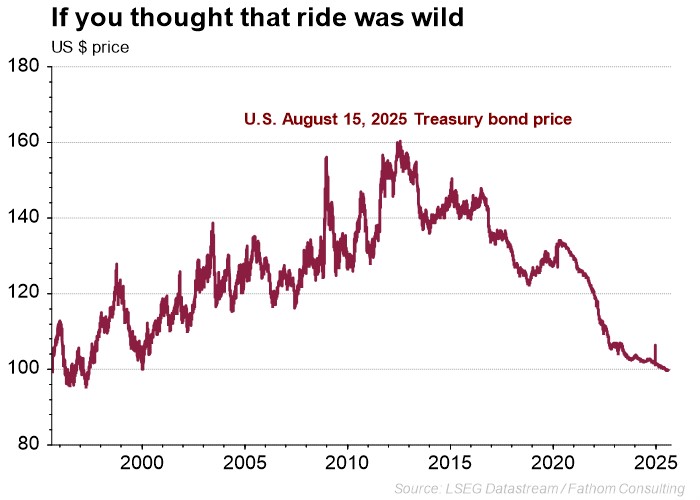
For comparison, let’s have a look at how the 30-year bond that just matured last month did over its lifetime. In the above chart, I have graphed the price of the August 15, 2025 U.S. treasury bond from its inception in 1995 to its maturity, which carried a coupon of 6.875%. Again, life for a bond starts and ends at $100. But see what happened during the first half of that life. Indeed, over the first 17 years, the price of this bond trended higher to reach a peak of over $160 in July 2012. It actually got close to that level during the financial crisis, when investors left equities in favour of safe harbours, like U.S. government bonds.
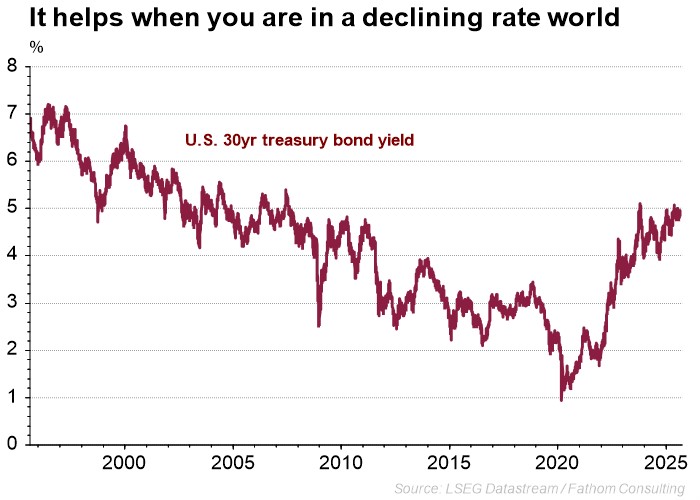
Even if one had not taken profits on their 30-year piece of paper when it reached its heights, the overall experience of holding to maturity wasn’t too stressful at all. In other words, if you have a magic crystal ball at the time of purchase, make sure the next 30 years is a period where, generally speaking rates are heading lower. While there was no crystal ball to be had, developments were such that projecting a lower rate environment wasn’t that hard. In the first half of the 1990s, inflation targeting was catching on among the world’s major central banks, we had a free trade agreement in North America and global trade was growing (and lending itself to lower inflation). As the chart below shows, the 30-year U.S. yield fell roughly 6 percentage points from 1996 to 2020.
I would argue that it is more difficult today to conjure up the same constructive view on where rates are going, at least over the near term. Yes, artificial intelligence offers the promise of increased efficiency and potentially lower inflation, but that influence is running headfirst into Trump’s counter free trade policies and increased destabilization of international ties. The fact that he wants to rename the Department of Defense, the Department of War, is not suggestive of a more cooperative world order. At the same time, a possible politicization of the Federal Reserve could end up in a situation where the Fed’s dual mandate of maximum employment and low inflation could be thrown out the window in favour of simply just getting rates down to pump-prime the economy before the mid-terms in 2026. Short-term gain, but potential long-term pain in terms of losing control of inflation. And, as I mentioned at the top, there is the erosion in global confidence in the fiscal path the U.S. is taking, resulting in higher term premiums that keep long-term yields on an upward trajectory. That would make for a 30-year holding period that is perhaps more stressful than the one enjoyed from 1995.
Hence, this is why Ally and I have been counselling against loading up on long-term bonds simply because of the wide spreads over short-term notes. That’s not to say we have zero exposure. Strange things could happen that cause long yields to fall. For example, we might get a recession in the U.S. that forces the Fed’s hand to lower rates without Trump’s whining. There are also other regions of the world where longer-term bonds face less secular risk than the U.S. (like Canada).
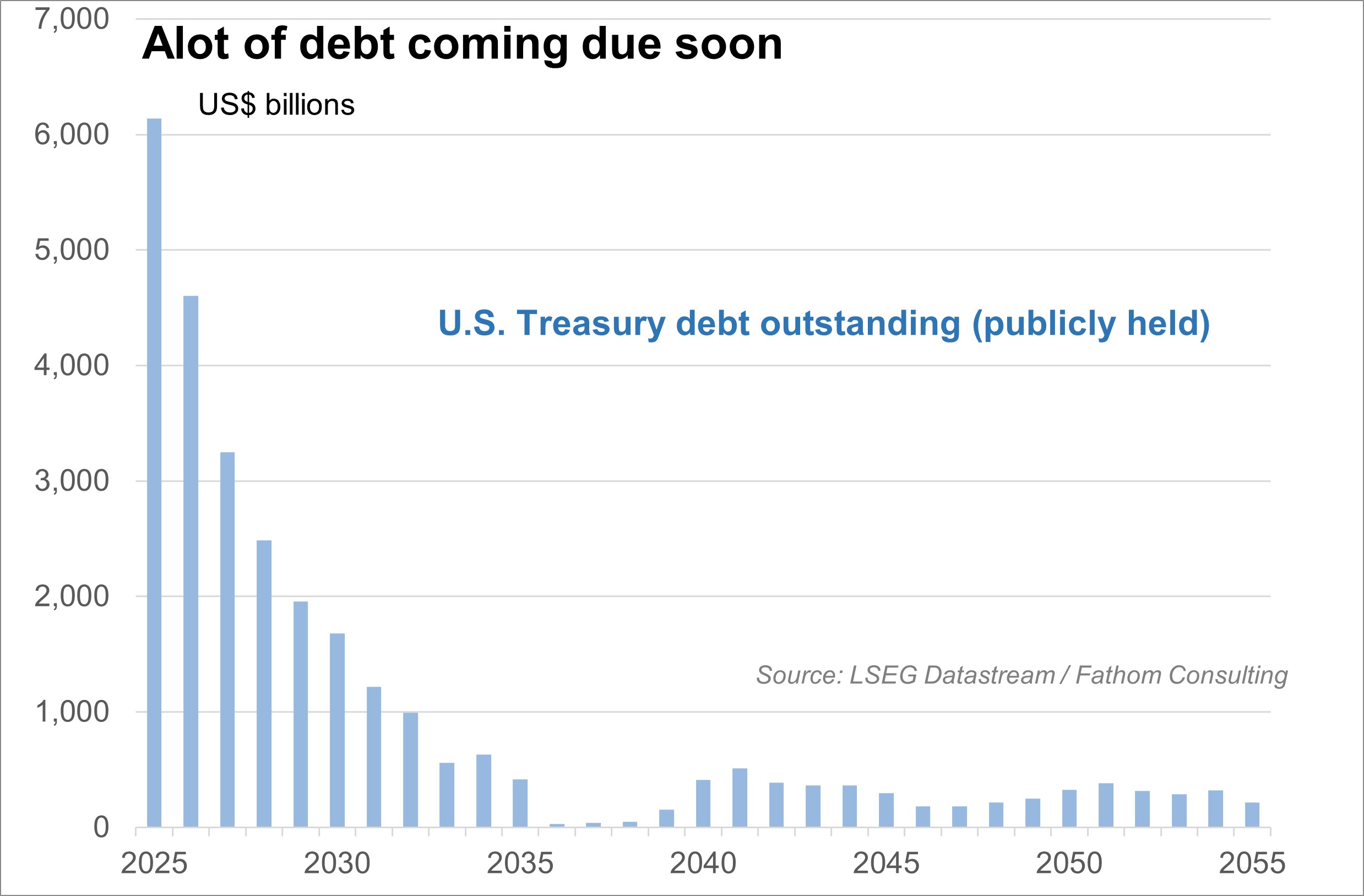
Given that we are now living in a world where anything coming out of Washington is possible, we also cannot rule out the possibility that the Treasury Department doesn’t toy with its debt management program. In other words, it may significantly reduce the amount of long-term bonds it issues, relative to shorter maturities. In addition to the bonds that are maturing over the course of the coming year, we also have a potentially higher government deficit. Yes, tariff revenues are coming in and there have been job cuts at the federal level, but slower tax revenue growth from a weaker economy is likely. If Shifting issuance towards the front-end of the curve could bring down long-term yields from reduced supply, but unless Trump gets his big, beautiful rate cuts, this shift could actually cause yields at the front-end of the curve to rise. This is because the 2-year yield, which might now be 1.3% below the 30-year, ultimately is anchored by where the overnight rate is. Adding to the supply of 2-year paper would at the margin cause that yield to rise.
At the time of writing, we had just seen another anemic jobs report out of the U.S. and an even more negative print in Canada. Where the U.S. 30-year yield had started the Friday session a hair above 5%, it then plunged to just below 4.80%. Does this negate everything we talked about? We don’t believe so and it might be the case that investors who have been holding long paper and worrying about the day of reckoning might just use this as an opportunity to find the door. The other aspect of this discussion is how the long end of the U.S. yield curve affects the stock market and we will cover that next week.
On behalf of the Pyle Wealth Advisory team, have a wonderful weekend.
Andrew Pyle
Related posts
Andrew Pyle
October 30, 2026
The Road Less Hiked
The road less hiked made all the difference this week, with the BoC opting to move while the Fed preferred to linger at the fork.
Read moreAndrew Pyle
October 23, 2026
Death and Taxes: Agonizing Over the Wrong Bill
The bill most families worry about after death is often not the one that costs the most. Good planning starts with knowing the difference.
Read more