




Andrew Pyle
July 18, 2025


Markets to the moon, minds in the mud
Somewhere between Jerome Powell’s careful tip-toeing around landmines being set by the White House, Trump’s continued tariff weave, and a surprisingly resilient earnings so far, the U.S. equity market appears to have adopted the Zen of denial. Equity indices have extended their post-April rebound and Bitcoin is now worth more than a 10% downpayment on a Toronto home. It’s not so much irrational exuberance—it’s calculated indifference, or what I call the great American shrug.
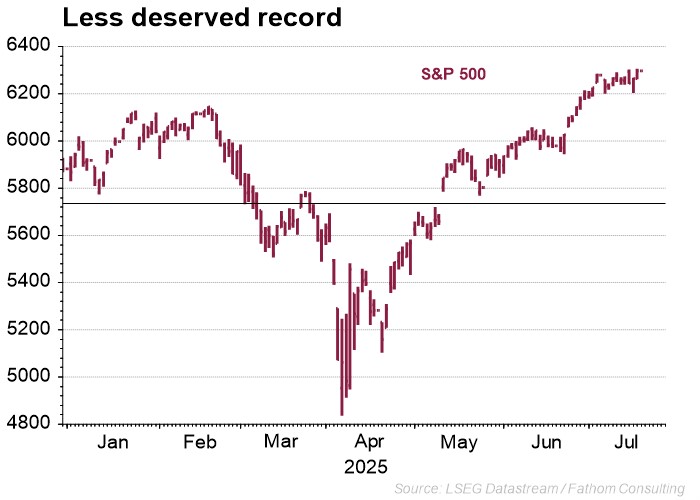
Let’s begin with the elephant in the room this week and that is the Powell TACO event. With the Federal Reserve holding the line on rate cuts in the face of economic data that neither suggests an implosion in demand or further decline in inflation, murmurings of discontent from the oval office have grown in volume. Calls for Chair Powell’s ouster have been as disguised as Yemen attack chat on Signal. I consider Bloomberg to be a credible news source, so when it released a headline saying Powell’s firing was taken up in discussion with Congressional leadership, it was probably correct. And yes, markets didn’t like it, but in true TACO fashion, Trump walked it back and investors went on their own merry way.
I think it’s safe to say that we are past the point of worrying about the event of Powell’s departure. To be honest, I can’t imagine the conversations between Jerome and his partner Elissa these days but I’m sure it involves something to the tune of “why are you still putting up with this?”. Where some might simply exit stage left, I believe that he is in it for the sake of the American economy. Legally, he cannot be fired and if he was, then we would be set up for months of legal entanglement to the point where his term would be over in the spring of next year anyway. Hence, this whole charade is simply a distraction from the real issue for markets and that is (A) who is going to be the next Chair of the Fed and (B) is Fed independence at risk?
There are three individuals at the top of the list of suggested replacements for Powell. You have Kevin Warsh, a former Fed governor (albeit with only 5 years of experience at the Fed) and someone who has Trump’s ear on monetary policy matters and also some obtuse ideas about how the Fed and Treasury should be more aligned. There is Kevin Hassett, the Chair of the Council of Economic Advisors, who is probably the most inclined to pick up the phone at the Fed when the oval office’s number shows on the screen. Finally, we have Scott Bessent, who is the current Treasury Secretary and probably the most liked by market participants. That said, markets like him in the Treasury role because of his perceived ability to damp down the more ridiculous fiscal policies coming out of Trump’s office for the sake of the U.S. debt market.
Again, at this stage, it doesn’t really matter who takes the helm of the Fed next year. Any of the above will be more likely to bend to Trump’s wishes for a sugar-rush decline in interest rates than Powell. True, the Federal Reserve Open Market Committee (FOMC) is a committee and one person’s push may not sway other members to deviate from the dual mandate of stable prices and full employment. There are three regional Fed presidents who’s terms end next year, but Trump has no direct influence on their replacement. That said, there are members of the FOMC who are dovish leaning and having a Trump surrogate in the Chair could increase the odds of faster rate cuts.
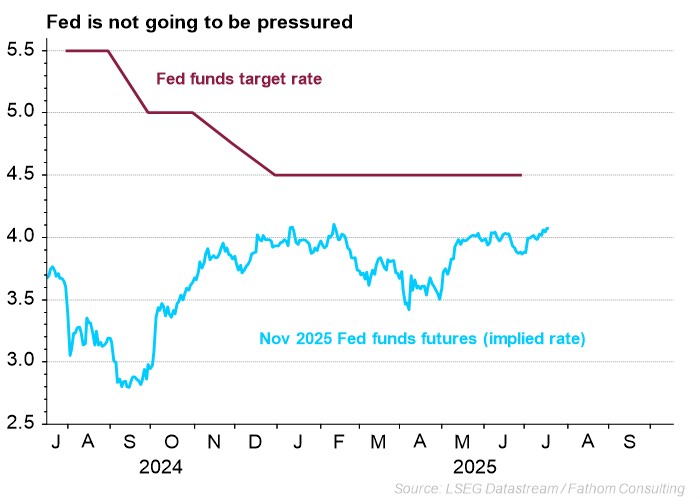
So, let’s assume all of this transpires and Trump gets his lower rates. The timeline for anything substantive is in the first half of next year at best. Considering that he is driven to continue the tariff tirade, to the detriment of U.S. and global economic growth, even if Powell was still the Fed chief this time next year, interest rates would have probably been cut as much as under any of Trump’s lackeys. To the extent that equity market participants are seeing the 2026 outcome through the same lens, then the apparent ignorance of gravity in stock prices might appear to have some credence, though I think it is a stretch to say that market participants are simply going to accept an attempted Trump takeover of monetary policy without a significant price tag.
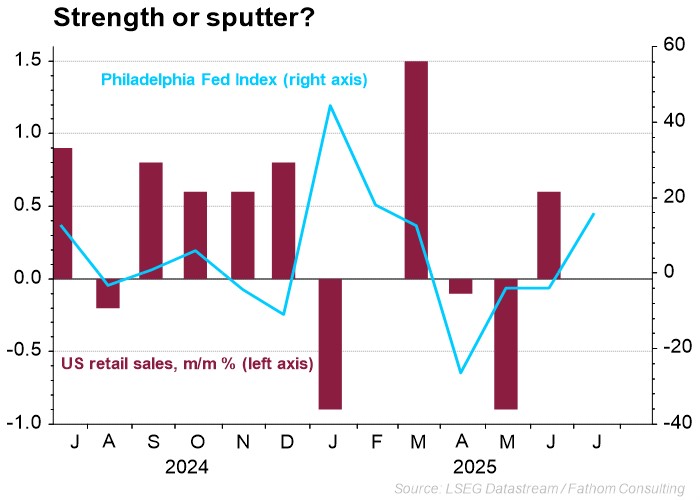
The problem is that to get that outcome, one also has to assume a weakening in the economy that overrides the upward influence on inflation from tariffs and allows the Fed to pull rates lower. So far though, the economy hasn’t rolled over. While business and consumer sentiment surveys have shown a material deterioration in recent months, the government-released numbers have so far painted a different picture. Retail sales for June came in with a 0.6% rebound after May’s 0.9% pullback. Economists were looking for a small gain of 0.1%. Even after stripping out autos, sales came in higher than expected with a 0.5% lift. As for business sentiment, the July Philly Fed index was a complete shock, coming in at plus 15.9 after a minus 4 read in June and against calls for another negative print.
What surprises many is how the economy can remain as resilient as it is given the policy vortex created by Trump. One reason is that the actual implementation of many of the tariff threats hasn’t materialized. Yes, the average level of tariffs imposed by the U.S. is still well higher than this time last year, but companies did a good job of stocking up prior to ‘liberation day’ in April. And with the latest deadline being pushed out to August 1st, firms are again going to stockpile as much as they can. This latter point is crucial, given that we are entering the period where companies typically place orders for items they plan to sell in the holiday shopping season. Theoretically, this front-loading of activity could lead to economic metrics that are not that dismal during the remainder of the summer. That might be good news for equity bulls, but it again does nothing for a near-term Fed rate cut sugar rush.
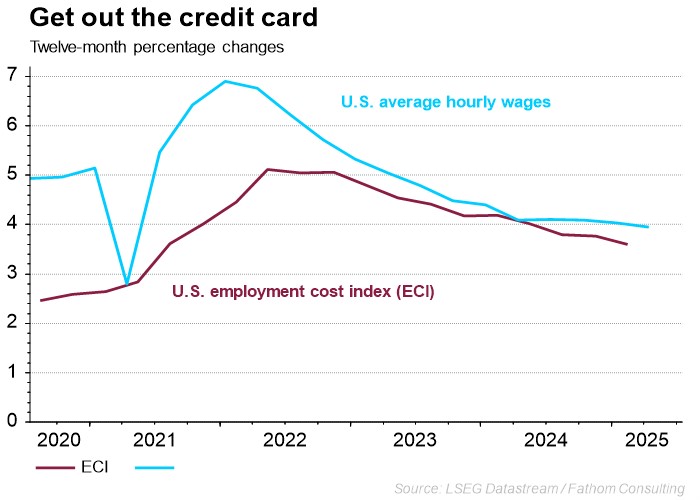
Then again, the decision about how much to order as we approach the fourth quarter isn’t just based on getting the pre-tariff price. It’s about what you think demand conditions will be like and whether the holiday season is going to be strong or weak? Yes, the June retail sales report was surprisingly strong, but the narrative of “resilience” is feeling thin. Wage growth is decent but is not keeping up with real costs in housing and services. As the above chart shows, the 12-month growth in average housing earnings fell to below 4% at the start of the second quarter and the employment cost index (ECI) saw growth slip around 3.5% at the same time. If you subscribe to the view that tariff cost pressures are only now starting to feed through to the consumer bottom line, despite any pre-stocking, then the only way spending is going to remain supportive is for households to take on more credit and we have already started to see that. However, without further relief on rates, the use of credit will also be more restrained.
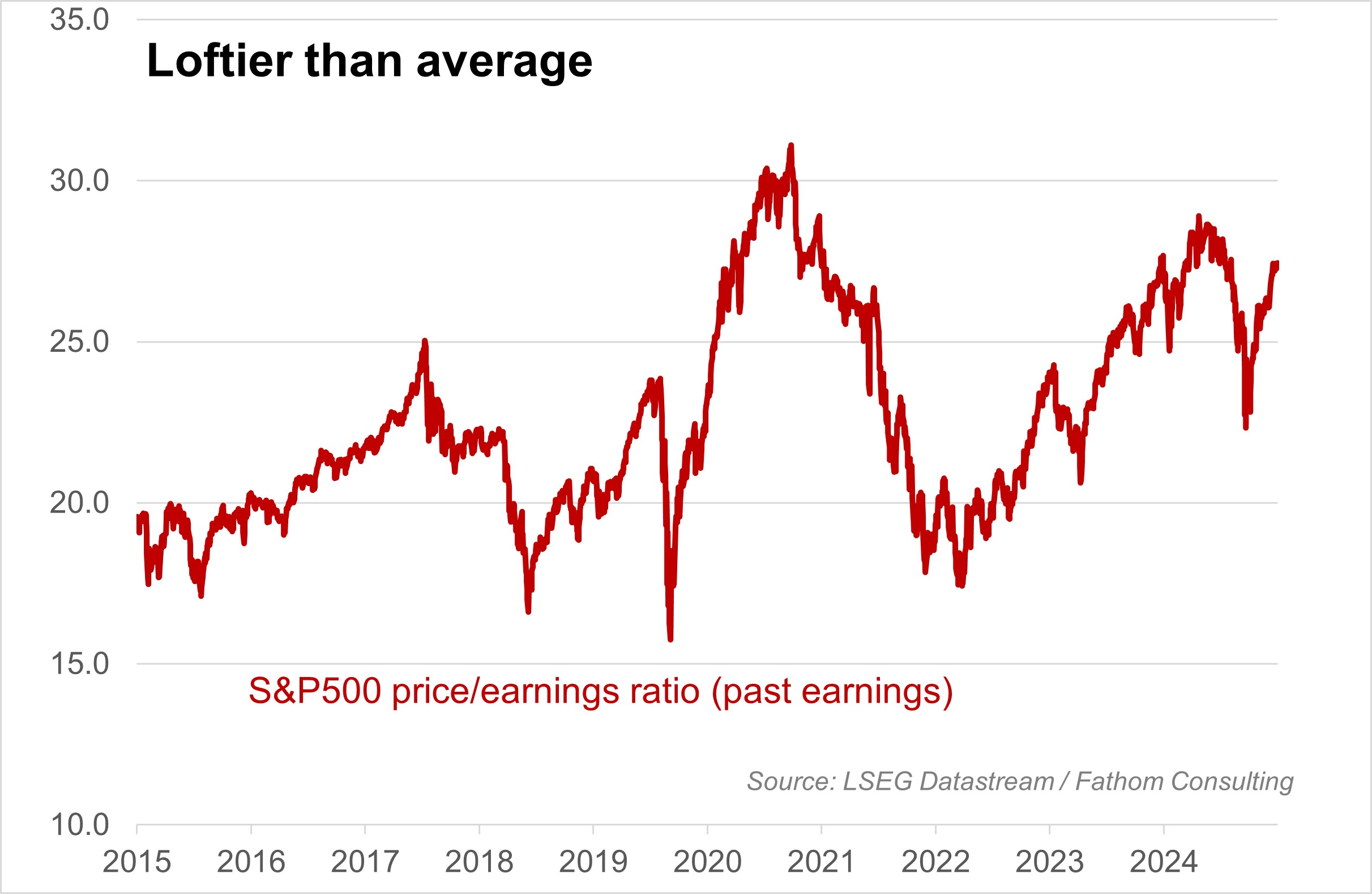
The apparent shrug in markets is also being driven by a fairly decent start to the earnings season this month and many investors believe that the S&P can continue to crank out double-digit earnings growth into 2026 and beyond. Indeed, U.S. banks delivered very strong results this week and the AI spending engine appears alive and well, at least for now. That said, valuations are looking stretched. With the rally this week, the forward price/earnings ratio for the S&P rose to above 22, which is about 4 points above its 10-year average. And the contribution to that multiple is coming from large-cap tech names, which again comes back to the AI spending question. Earnings expectations are beatable—but forward visibility is cloudy.
While a higher than average multiple isn’t always a leading indicator for correction, it becomes harder to justify when we have things like tariff uncertainty and implied pressure against Federal Reserve independence. Markets seem calm today and, but not necessarily confident. Some of the advance in stocks is also being driven by FOMO (fear of missing out) and that is probably the shakiest of reasons.
On behalf of the Pyle Wealth Advisory team, have a wonderful weekend.
Andrew Pyle
Related posts
Andrew Pyle
October 30, 2026
The Road Less Hiked
The road less hiked made all the difference this week, with the BoC opting to move while the Fed preferred to linger at the fork.
Read moreAndrew Pyle
October 23, 2026
Death and Taxes: Agonizing Over the Wrong Bill
The bill most families worry about after death is often not the one that costs the most. Good planning starts with knowing the difference.
Read more