




Andrew Pyle
July 12, 2024


Growth or Value?
There’s a phrase that we have heard about a lot these days and that is “rip up the playbook”. We generally use this when we think that times are far removed from normal and that our historical analysis and prescriptions just don’t appear useful. Given the current U.S. presidential election campaign, some believe we just go right to the shredder or bonfire. If we thought the 2020 election offered up some uncertainty, then this one takes the cake. As we have discussed with clients in recent months, this feels very much like a replay of 2020 in terms of how the summer is progressing and what could await us in the fall; however, there might yet be some pages from the playbook that could provide useful guidance.
Back in late summer of 2020, after equity markets had embarked on a rally that very few could have imagined, the risk-reward balance looked skewed, in our opinion, towards the risk side of things as the election date grew closer. The prudent approach was to do some de-risking and park in cash until the election dust settled. We may very well want to take that same tactical approach this time around yet, aside from simply trimming equity exposure, should we also be shifting our stance in the types of stocks we own? There are many ways in which we differentiate parts of our portfolio. That can be geographical, or we can look at sectors of the market such as energy versus financials. In terms of international macroeconomic trends and domestic cyclical observations, these work well. But sometimes within a particular market, there are other shifts that can take place and that would include the movement of capital between growth stocks and value stocks.
Let’s take a step back and look at what exactly a growth stock is and why some stocks are assigned a value label. In the simplest sense, growth stocks are in industries or sectors that are experiencing strong expansion. These companies tend not to pay high dividends or any dividends at all because they reinvest earnings in the business to achieve stronger growth. Investors that buy these stocks are counting on continued growth and therefore higher stock prices.
Value stocks, on the other hand, are those that for whatever reason are trading at levels that are below their fair or intrinsic value. For example, they may have lower ratios such as price-to-earnings, price-to-book value, or price-to-sales compared to others. This might be because the sector they belong to has fallen out of favour with investors, or that the company itself is not being valued as high as it should because of news events. There are a number of different indexes and securities that are invested in so-called value stocks and they have different methodologies when it comes to scoring stocks on the degree to which they exhibit value characteristics. Because of that, the constituents of each may be different.
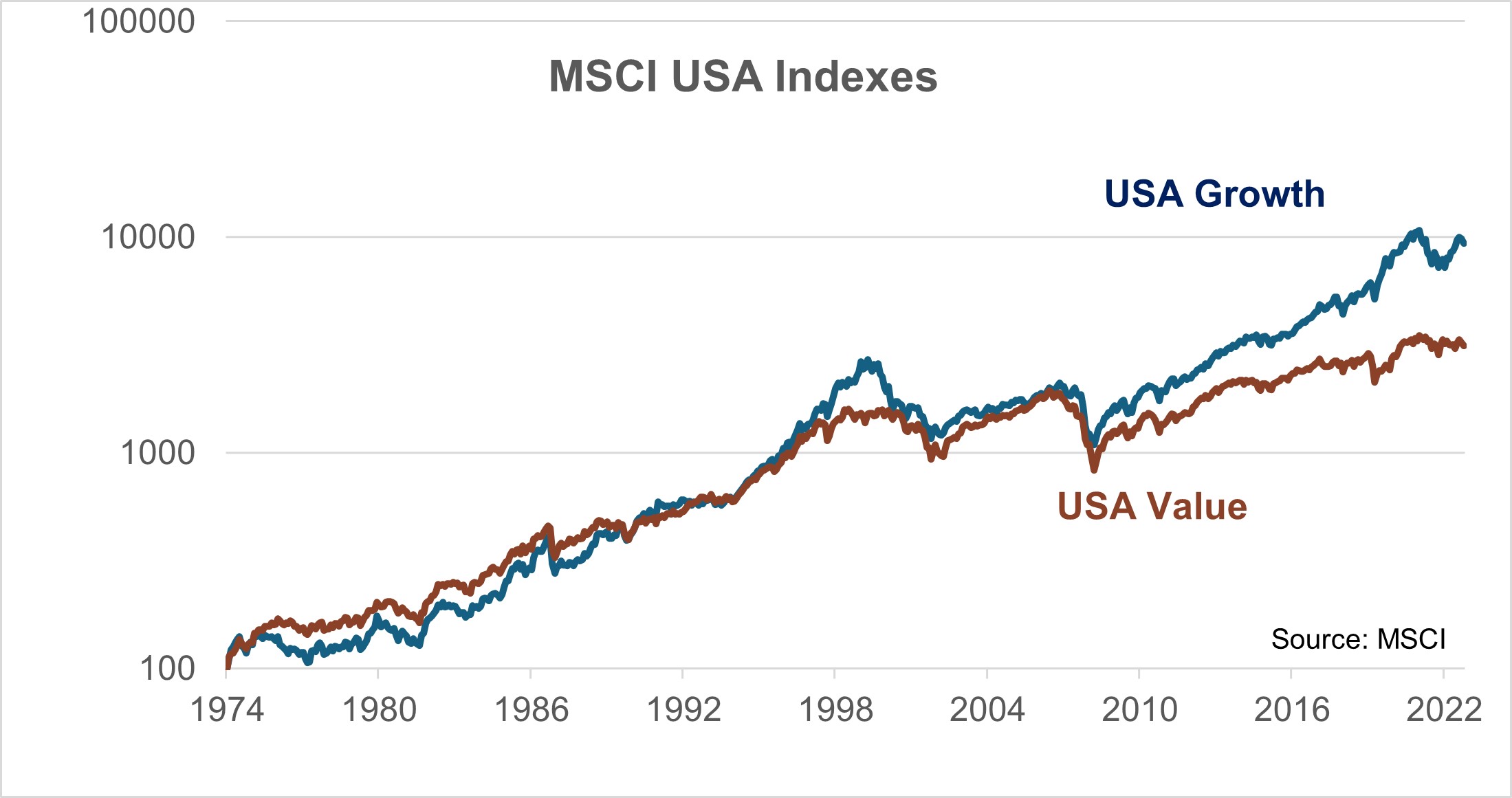
The above chart shows the MSCI index for U.S. growth stocks and value stocks going back to the mid-1970s, indexed to December 1974. From a return perspective, it is clear that growth stocks have outperformed over the past half a century, though there was minor deviation between the two segments until after the great financial crisis. Since then, the performance gap has widened and is now the largest on record.
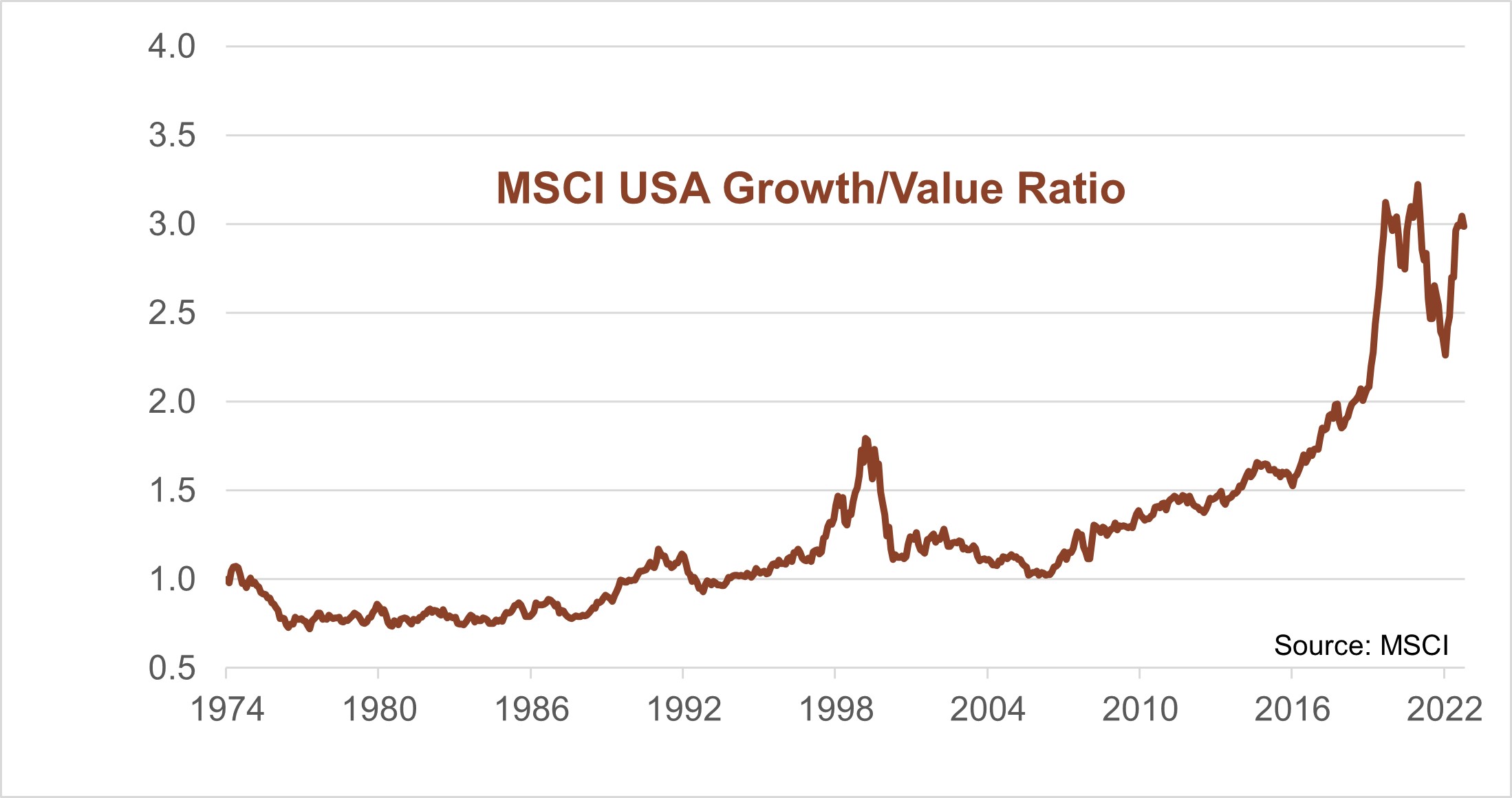
This can be seen more clearly when we look at the ratio between the MSCI growth and value indexes, which are shown in the chart above on a monthly basis. Prior to around 1996, the ratio spent most of its time below one and didn’t really start to push significantly above this level until the late-1990s (remember the internet boom). The subsequent tech bust saw the ratio trend back towards one, but since the end of 2006, the ratio has steadily climbed and broke above three in 2021. There was a sharp decline in 2022, but here we are in 2024 with a ratio north of three. The way we interpret this ratio is that when it is climbing, growth stocks are outperforming and vice versa.
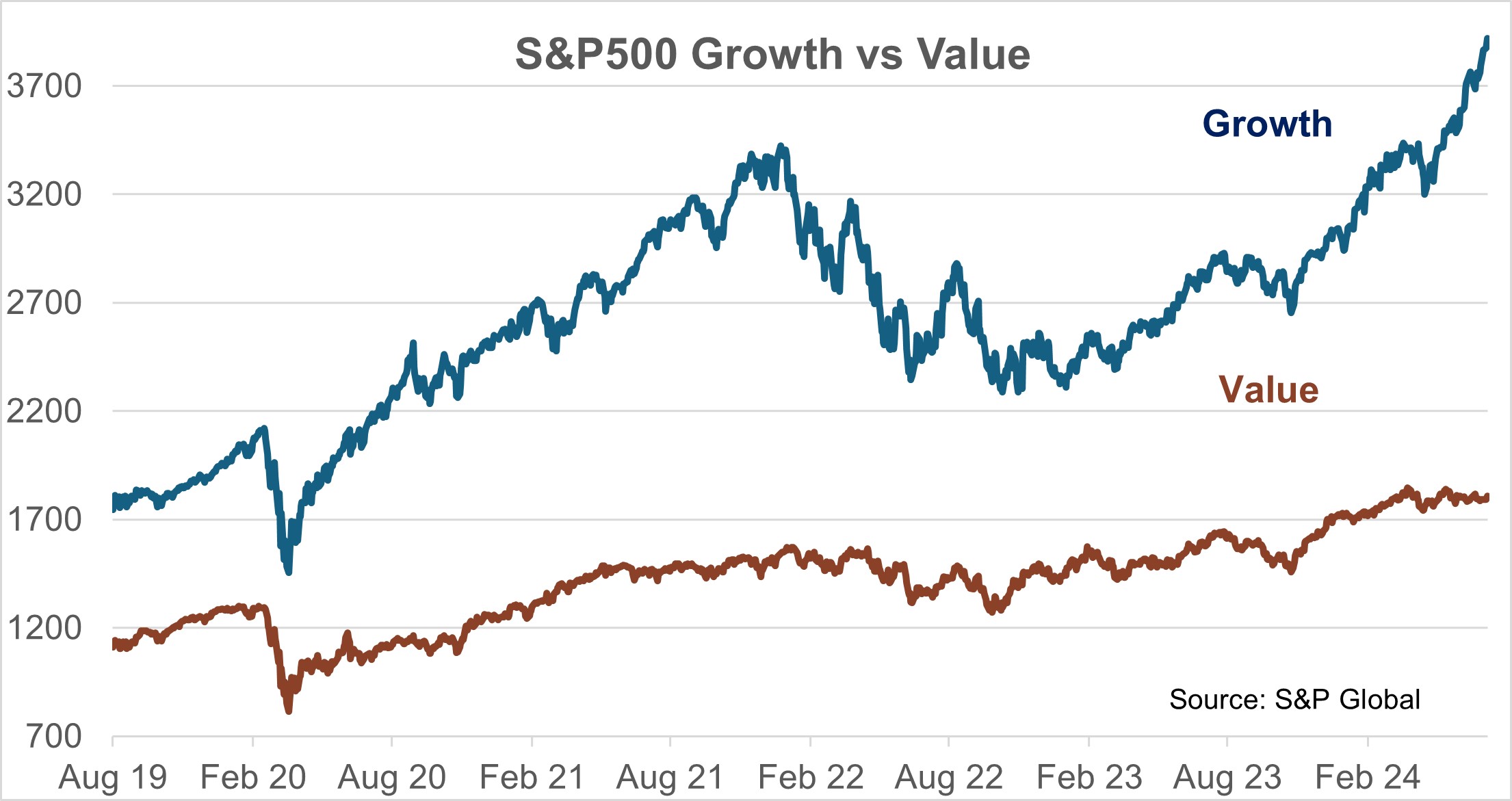
Using the S&P500 indices, we have looked at daily data going back to 2019. Again, growth stocks have taken off this year relative to companies trading at a discount to their fair value. The ratio of the two is not quite back to where it was at the end of 2021, when it hit a high near 2.3, but it is significantly higher than where we closed the books of in 2022. But, what about the playbook?
Going back through time, we tend to find that the ratio between growth and value stock performance declines when we are in recessions, episodes of higher inflation and interest rates, as well as periods of heightened market uncertainty (including the politically generated type). Looking at the same ratio of S&P500 growth to value indexes, we do find that it fell back from the start of September in 2020 through to the end of the year. In other words, this period not only saw stocks back-peddle (reinforcing our tactical approach of trimming equity exposure in general), but the remaining equity exposure did better if tilted towards value stocks.
Considering developments on the political stage in recent weeks, the probability of volatility remaining low this fall is low, in our opinion. That doesn’t mean something could happen to provide calm to market participants but in the absence of that, we are going with our 2020 playbook in terms of portfolio positioning. Investors may look to make a general shift away from North American equities in favour of bonds (if they are not in an overbought situation) or cash, while adding exposure to more value-oriented stocks.
On behalf of the Pyle Wealth Advisory team, have a wonderful weekend.
Andrew Pyle
CIBC Private Wealth consists of services provided by CIBC and certain of its subsidiaries, including CIBC Wood Gundy, a division of CIBC World Markets Inc. The CIBC logo and “CIBC Private Wealth” are trademarks of CIBC, used under license. “Wood Gundy” is a registered trademark of CIBC World Markets Inc.
This information, including any opinion, is based on various sources believed to be reliable, but its accuracy cannot be guaranteed and is subject to change. CIBC and CIBC World Markets Inc., their affiliates, directors, officers and employees may buy, sell, or hold a position in securities of a company mentioned herein, its affiliates or subsidiaries, and may also perform financial advisory services, investment banking or other services for, or have lending or other credit relationships with the same. CIBC World Markets Inc. and its representatives will receive sales commissions and/or a spread between bid and ask prices if you purchase, sell or hold the securities referred to above. © CIBC World Markets Inc. 2024.
The contents of this communication are for informational purposes only and are not being provided in the context of an offering of any security, sector or financial instrument, and is not a recommendation or solicitation to buy, hold or sell any security.
If you are currently a CIBC Wood Gundy client, please contact your Investment Advisor.
Related posts
Andrew Pyle
October 30, 2026
The Road Less Hiked
The road less hiked made all the difference this week, with the BoC opting to move while the Fed preferred to linger at the fork.
Read moreAndrew Pyle
October 23, 2026
Death and Taxes: Agonizing Over the Wrong Bill
The bill most families worry about after death is often not the one that costs the most. Good planning starts with knowing the difference.
Read more