




Andrew Pyle
December 01, 2023


Two years later and the story is finally coming together
The other week, I discussed how North American economic fundamentals were starting to ebb and that Canada’s deceleration was becoming even more pronounced. This week’s data continued to highlight the emerging weakness on both sides of the border, which fueled that age-old market reaction of “bad is good” once again. Bad in the sense that we are coming off the boil in terms of economic expansion, but good in that inflation can keep falling. Recall that it was about two years ago that we saw inflation get to levels that were becoming worrisome. It was around that time that central bankers were following the mantra that this inflation surge would be temporary, or “transitory”.

As the above chart shows, consumer price (CPI) inflation in both Canada and the U.S. has declined to the 3% area – levels that we have not seen since the early part of 2021 and a far cry from where we were at the end of November that year. Actually, we are close to the peak inflation seen in 2018, which coincided with the pre-pandemic central bank tightening phase. Back then, policy was more pro-active. Rather than wait for inflation to shoot past the 2% targets at the Bank of Canada and Federal Reserve, rates were increased in anticipation of excess demand causing a trend increase in inflation. That policy worked, as economic activity cooled and inflation moderated into 2019.
In November of 2021, policy was neither pro-active or reactive. It simply was in spectator mode – a stance that continued until of March of 2022. Criticism of how both central banks dealt with the inflation problem of 2021 was deserved, though at some times a little too harsh. In hindsight, we know that the high inflation experience of 2021 did turn out to be transitory. The problem was that central bankers didn’t communicate the context properly, in addition to not taking enough pro-active measures. Well, that is in the rearview mirror and, judging by the movement in both stocks and bonds this month, it looks as thought market participants are willing to forgive and forget. As we close the books on November, the tone has definitely improved. The TSX rose an impressive 6.7% on the month – not too far behind the roughly 8% gains in the Dow Jones and S&P500 indices. European equities also staged a comeback, though with the UK not surprisingly trailing.
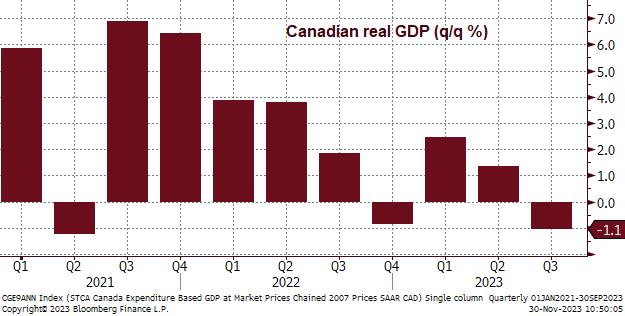
Again, this improvement has been driven by the data. In Canada, we learned this week that the economy contracted by 1.1% in the third quarter. This would have been the second consecutive decline had it not been for the upward revision to the previous quarter – now showing a 1.4% expansion, versus the original print of a 0.2% drop. Still, as we have been telling clients in recent weeks, the Canadian economy has likely entered a recession going into 2024, unless there is a surprising rebound in activity in the remaining months. Outside of trade, indicators support the view of continued malaise, from employment to housing. This morning, Canada released labour market data, surprising on the job gain with an addition of 25,000 for the month of November. However, this was coupled with an uptick in the unemployment rate by 0.1 percentage points to 5.8 percent, marking a 22-month high. This is one of those rare occasions when we get the latest Canadian labour force report before the U.S., given the timing of their Thanksgiving.
South of the border, it has been more of a Goldilocks story, at least for now. As we saw this week, personal spending in October cooled, with growth of 0.2% on the month versus 0.4% in September. And the PCE price deflator was flat, while the core deflator rose only 0.2% from 0.3% in September. That difference may not seem that great, but on an annualized basis it means a rate of core PCE inflation that is closer to 2.5% from 3.5%. On top of that, the 6-month moving average for the core deflator is back to 0.2% for the first time since February 2021. Barring a negative shock from next week’s slew of U.S. indicators, the Goldilocks story is holding.

As mentioned, it wasn’t just the stock market that enjoyed a fabulous November. Bonds on both sides of the border rallied strong during the month, sending yields back to September levels for the U.S. government market and August for Canada. In the space of a month, Fed funds futures and Canadian BA futures have each priced in an additional half a percent easing by the respective central banks by December of next year. In the case of the U.S., this takes us back to levels seen in August, but Canadian pricing is now where we were at the start of June – just prior to the second last rate hike from the Bank of Canada. The fact that we are now seeing contraction in Canadian reports reinforces our view that the Bank is not only done in terms of rate hikes, but will likely be the first to cut this cycle.
But, where are we relative to that time two years ago, when things were supposed to be transitory? Well, in the case of the bond market there is still a long way to go. The U.S. 10-yr yield back then was around 1.5%, or roughly 3% below today’s level and Canada’s benchmark 10-yr yield was around the same. In our opinion, this correction over the past two years will not be fully recovered, unless we run into a major financial crisis that results in a reversal in central bank policy back to zero rates. I would further argue that, aside from the fact that we don’t want such a crisis, we don’t want to go back to rates that low given all the distortions it created in the first place.
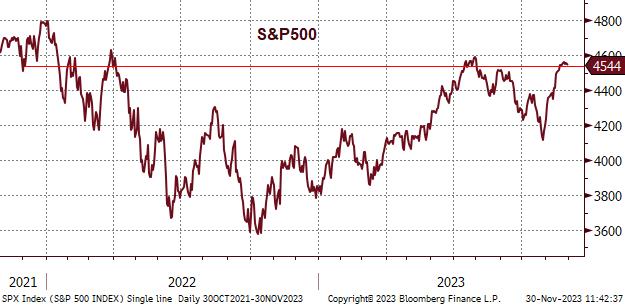
The stock market is different. As much as people talk about the strong advance in U.S. stocks, albeit with a decent dose of volatility since the summer, the fact of the matter is that we are still basically unchanged over these last two years. Back then, we ended November on a weak note, following a surge in October. December delivered a Santa Claus rally to bring the S&P500 to a new record by the start of 2022. Today, the index continues to struggle at below 4600 and it’s possible that this turns out to be the opposite experience of November-December of 2021. That said, even if stocks are unable to pull off a holiday season rally, we should be able to resume an upwards course in 2024 and eventually set a new high.
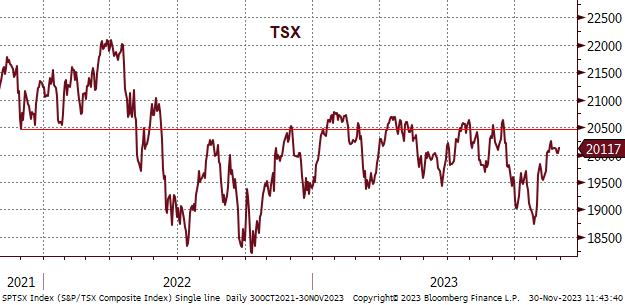
The performance by the TSX over this period has been less impressive, but at just above 21,000 the index is only 500 points shy of where it was at the end of November in 2021. Considering that the index does not have the weighting to tech that the S&P does and that energy has not exactly been a growth leader, this really isn’t a bad outcome. The TSX hit an all-time high above 22,200 in April of 2022 so there would appear to be even more upside for Canadian equities in a scenario with general stock market activity that is constructive next year.
There are two main takeaways from this. First, the transitory call on inflation wasn’t exactly wrong, it’s just that it was premature. While there are certain categories that will see inflation remain sticky, thus preventing an actual return to 2% for some time to come, the trajectory will eventually satisfy the Federal Reserve and allow for rate cuts by this time next year. Canada will be ahead of the game. Second, maneuvering the portfolio through this two-year transition required some degree of defensiveness, but remaining largely invested still allowed for capital to be rebuilt from the effects of 2022. For those that crystallized losses on a wholesale level, in search of GICs, that capital didn’t return. That’s not to say it’s too late to shift back into a balanced portfolio strategy, especially with bond yields still elevated. Stocks may seem inflated after November and we may want to wait for cheaper levels to emerge, but these two years have taught us once again that it is “time in the market” versus “timing the market” that works.
On behalf of the Pyle Wealth Advisory team, have a wonderful weekend.
Andrew
CIBC Private Wealth consists of services provided by CIBC and certain of its subsidiaries, including CIBC Wood Gundy, a division of CIBC World Markets Inc. The CIBC logo and “CIBC Private Wealth” are trademarks of CIBC, used under license. “Wood Gundy” is a registered trademark of CIBC World Markets Inc.
This information, including any opinion, is based on various sources believed to be reliable, but its accuracy cannot be guaranteed and is subject to change. CIBC and CIBC World Markets Inc., their affiliates, directors, officers and employees may buy, sell, or hold a position in securities of a company mentioned herein, its affiliates or subsidiaries, and may also perform financial advisory services, investment banking or other services for, or have lending or other credit relationships with the same. CIBC World Markets Inc. and its representatives will receive sales commissions and/or a spread between bid and ask prices if you purchase, sell or hold the securities referred to above. © CIBC World Markets Inc. 2023.
Andrew Pyle is an Investment Advisor with CIBC Wood Gundy in Peterborough. He and his clients may own securities mentioned in this column. The views of Andrew Pyle do not necessarily reflect those of CIBC World Markets Inc.
Yields/rates are as of November 30, 2023 and are subject to availability and change without notification. Minimum investment amounts may apply.
GIC - For more information about this product, please contact your Investment Advisor.
Related posts
Andrew Pyle
October 30, 2026
The Road Less Hiked
The road less hiked made all the difference this week, with the BoC opting to move while the Fed preferred to linger at the fork.
Read moreAndrew Pyle
October 23, 2026
Death and Taxes: Agonizing Over the Wrong Bill
The bill most families worry about after death is often not the one that costs the most. Good planning starts with knowing the difference.
Read more