




Andrew Pyle
May 27, 2022


North American economy in final approach
Thankfully, the daily drone of panic over imminent recession has started to fade as we head into the final month of the quarter; just as the heightened concern over rapidly rising interest rates has ebbed ever so slightly. I believe we all deserve a reprieve. It's a tad ironic, however, that this nascent calm is taking place just as we start to see economic indicators cool off. Companies are also bending their forward guidance for revenues and earnings slightly lower – validating the declines in share prices over the last several weeks.
As we have commented before, a slowing economy is not necessarily a bad thing if it means inflation will come down and central banks might not have to execute the size of rate hikes market participants were fearing. Let’s start with Canada. After peaking at close to 250 at the end of April, the Citi Economic Surprise index for Canada has fallen through May. At just over 200, it's still quite elevated to where it was at the start of the year, but we are seeing misses in the key indicators.
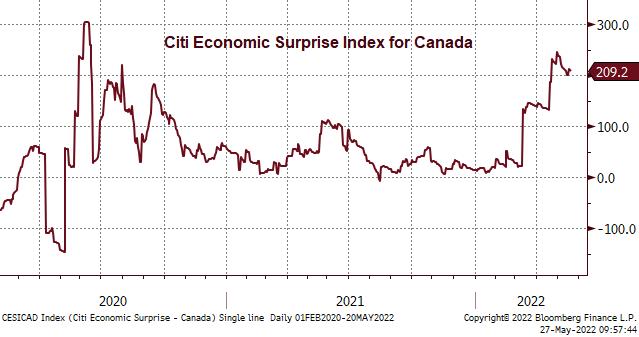
Net exports at the end of March came in softer than economists had predicted, and then we saw much weaker-than-expected jobs gain of 15,000 for April (with a 31,600 drop in full-time employment). Yesterday, StatCan reported that retail sales were flat in the month of March and were down 1% in price-adjusted terms. That works out to about a 5% decline in volume sales from this time last year. While early estimates suggest a bounce of 0.8% in April, we do expect May to show sluggishness in the wake of higher rates and the surge in fuel costs.
While we have seen less optimistic numbers on the economy of late, there has also been an incongruency in how the labour market continues to tighten. StatCan reported that there were north of 1 million job openings in March – a new record – and that the job vacancy rate also matched last September’s record high of 5.9%. I know, this doesn’t make a lot of sense. We had supposedly recovered all the job losses from the pandemic, yet there is insatiable demand for labour and recent employment gains have diminished. What gives? Well, for one, we didn’t actually recover all the lost jobs – at least not full-time jobs. The rebound stalled last August when full-time payrolls peaked at 15.9 million – below the pre-pandemic peak of just over 16 million. As of April, payrolls were at 15.6 million. And, if the economic plane really is coming in for a landing, those job vacancy ads are going to decrease as firms look to cut costs.
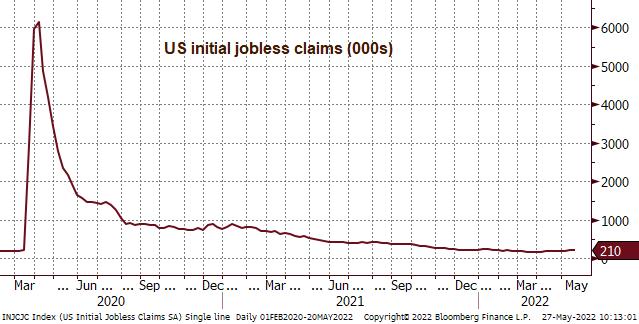
A similar pattern is playing out in the US. After what can best be described as a miraculous resurgence in the labour market after the forced shutdown in 2020, there are indications that things are starting to give. Initial jobless claims, which often give us a preview of things to come in the overall unemployment picture, have been gradually moving higher since March of this year. Looking at the above chart, this increase looks minor compared to the decline from the peak of the pandemic; yet the 26% increase from the recent low shouldn’t be ignored. We have definitely seen similar or larger moves in the past. As recently as the second quarter of 2019, initial claims jumped 40% from a half-century low of 173,000.
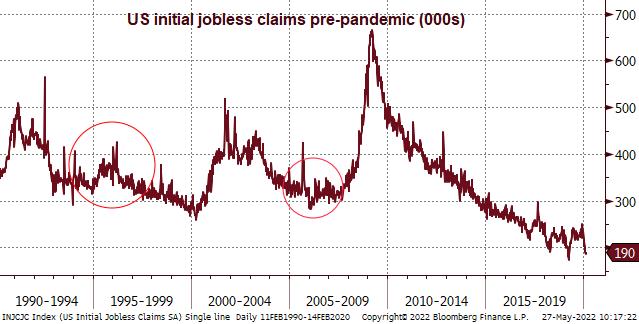
I believe this chart gives us some better insights. Prior to the pandemic, turns in the US claims figure were fairly good indications that a measurable slowdown was afoot. Even if you look at 2019, you see that claims were starting to turn higher. This was highly anticipated and many of you will recall our conversations of 2019 as to how the economic expansion had grown to a record number of quarters in the US. The pandemic just produced a huge distortion in what was a normally occurring slowdown. Sometimes, turns in jobless claims do not signal impending recessions. This was the case in the mid-90s and again in 2006. That said, the latter wasn’t far off the mark given what happened two years later.
Another big difference between now and those other periods is that we are dealing with lofty inflation, compared with low and steady inflation back then. The new theory being played around with in the markets this week is that this softening in economic data is reflective of actual underlying weakening in demand. That weakening then leads to a re-balancing of supply and demand forces which, in turn, dampens inflation and allows central banks the opportunity to recalibrate the degree of monetary policy tightening that is needed. Stocks are certainly buying into this theory, as evidenced by the bounce off of last Friday’s lows. There is still a long way to go before the narrative switches from outright bearishness to another sustained upturn.
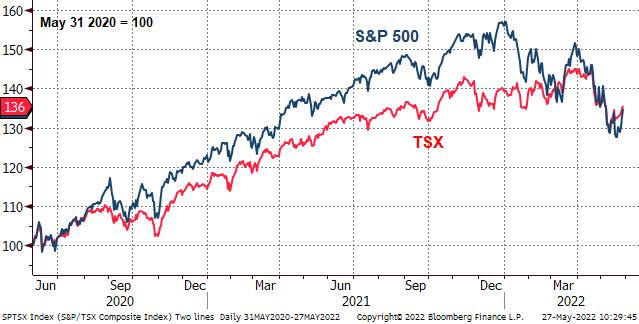
A number of things have to come together, not including what happens with Ukraine. Inflation has to lose altitude quickly and the Fed and Bank of Canada actually have to signal a pause in hikes or actually deliver one. In terms of the major stock indices, we do need to see this recent rally falter so that we can re-test recent lows and see if they stick. That means another potential move lower in the S&P500 to the 3800 area and a return by the TSX to around 19,500. If these altimeter levels hold, then it's possible to see a more sustainable summer upturn; though odds of that are better for the US than Canada, in my opinion. If so, then we have actually witnessed one of the most successful attempts at a soft landing by central banks; not because of actual rate adjustments, but by allowing the market to create its own sense of panic around rhetoric.
On behalf of the Pyle Group, have a wonderful weekend.
Andrew Pyle
CIBC Private Wealth consists of services provided by CIBC and certain of its subsidiaries, including CIBC Wood Gundy, a division of CIBC World Markets Inc. “CIBC Private Wealth” is a registered trademark of CIBC, used under license. “Wood Gundy” is a registered trademark of CIBC World Markets Inc. This information, including any opinion, is based on various sources believed to be reliable, but its accuracy cannot be guaranteed and is subject to change. CIBC and CIBC World Markets Inc., their affiliates, directors, officers and employees may buy, sell, or hold a position in securities of a company mentioned herein, its affiliates or subsidiaries, and may also perform financial advisory services, investment banking or other services for, or have lending or other credit relationships with the same. CIBC World Markets Inc. and its representatives will receive sales commissions and/or a spread between bid and ask prices if you purchase, sell or hold the securities referred to above. © CIBC World Markets Inc. 2022.CIBC Wood Gundy, a division of CIBC World Markets Inc
These are the personal opinions of Andrew Pyle and may not necessarily reflect those of CIBC World Markets Inc.
Related posts
Andrew Pyle
May 04, 2022
Fed Up!
The Federal Reserve has stepped up its program of rate hikes, with a half a percent increase today. While it's possible we could see further aggressive tightening, there are headwinds to growth that ...
Read moreAndrew Pyle
May 13, 2022
Sometimes markets advise us as much as worry us
Not since the financial crisis have Canadian investors needed some strong hand-holding, given the market volatility of the past few months. Education and counseling even more important and tells us to...
Read more