




Andrew Pyle
September 03, 2026


Flat tire and no gears
Three years ago, I bought my first serious road bike and participated in my first Sick Kids Great Cycle Challenge. And each August since, I raise the bar – this year, aiming for 300 km. But, with my schedule full during the month I was having to squeeze in rides where I could. By the last day of the month on Monday, I still needed 38 km, so I set out for a what I thought was going to be a straightforward 90-minute trip through Ennismore. Unfortunately, my bike had different plans and 24 km in, my rear tire gave out — not a slow leak, a full blowout, the kind that ends any illusion you're finishing on your own equipment. Covered in blue sealant, Pam picked me up and we went out for Ally’s birthday dinner. Coming up 14 km short of my goal didn’t sit well at all so I asked a neighbour if I could borrow one of their youth bikes. With a head lamp on, I proceeded to cycle around a dark island, with one working brake and no gears. The rain added to the treat. Undignified? Absolutely, but I completed the goal – tired legs and all.
I bring this up because it's basically a metaphor for the bond market right now, which is experiencing its own version of a blowout of late. The 30-year U.S. Treasury yield closed above 5% on more days so far in 2026 than in any year since 2006, and it touched levels in mid-August not seen since 2007, as you can see in the chart below. The 10-year is sitting near 4.80%, its highest point since October 2023. This isn't a one-week wobble — it's a slow-motion correction that's been building pressure since the spring. Three things are doing most of the work here, and none of them are new, but together they're compounding.
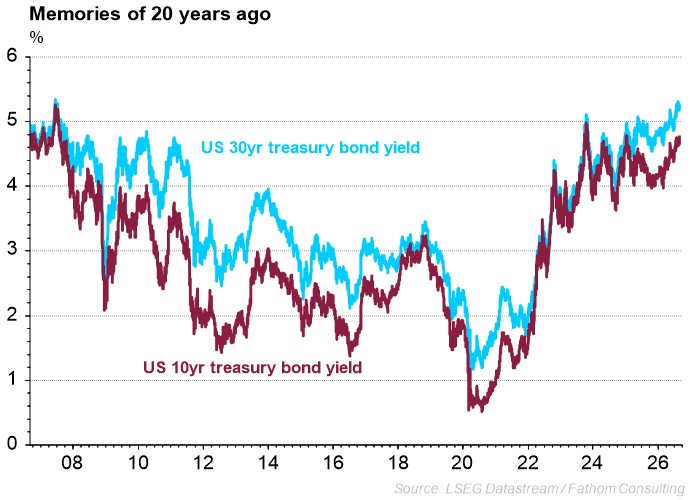
First of all, we have higher inflation, driven in part by Middle East tensions. The escalation between the US and Iran has pushed oil prices higher for three straight sessions, taking Brent crude futures above $95/barrel. Yet, this isn’t the big story. Crude oil has hit loftier levels this year and, while we may still see a continued climb as the US and Iran fire missiles at each other, it is the downstream market that is causing real anxiety. The US Gulf Coast FOB diesel swap price broke above $4.40 per gallon this week and retail diesel prices are north of five bucks. Persistently high energy prices are still the fastest way to reignite inflation expectations and this spooks bond investors.
Second, we not only have tariffs from last year that are working through the supply chain, but Mr. Lake America himself continues to wage trade war with anyone that looks at him the wrong way. With respect to the breakdown in Canada-US trade talks, I was initially hopeful that the adults would return to the table before Labour Day. If not, and retaliatory tariffs are implemented, then bondholders are going to have to keep pricing in uncertainty about how long this lasts. Unlike a one-time price shock, tariffs tend to show up in inflation data with a lag.
Third, the mountain of government debt continues to grow, with outstanding US Treasury securities now exceeding $40 trillion. The U.S. government's financing needs keep growing, not just from the increased demands stemming from the fiasco in the Middle East, but because interest payments on US debt now account for roughly 14% of the entire annual budget. Add to this the fact that corporations have been coming to market in wave after wave of new issuance, largely in the tech space. For now, credit quality isn’t a problem and despite higher all-in yields, historically tight spreads against government yields means that this market still works for most large-cap borrowers.
That said, when you have more supply, at a time when the marginal buyer is already asking for a bigger premium to hold duration, is a straightforward recipe for higher yields. Layer on top of that a new Fed chair who used his first big platform — the Jackson Hole speech — to commit to fighting inflation, and markets are now pricing in meaningfully increased odds of a rate hike rather than a cut this month. That's the opposite of what most portfolios were positioned for at the start of the year, and repositioning isn't free.
The move has also reshaped the curve itself. The 2-year has held fairly steady near 4.40%, while the 10-year and 30-year have done most of the climbing — a "bear steepener," in trader-speak, with the 2s30s spread widening to around 88 basis points. Traders love a good steepening story, but before we get too carried away with the slope, it's worth asking whether the slope is even the part that matters most here.
Slope Isn't the Whole Story
Some of the hills in our local community aren't anywhere as steep as what I find on my bigger rides around Ennismore. But on a bike with no gears, in the dark, after a 24 km ride that went sideways, they definitely felt steep. I still had to stand up out of the saddle and grind through every one of them.
That's roughly where the yield curve is right now. An 88-basis point 2s30s spread is wider than it's been in a while, but it's nothing like the steep curves we've seen coming out of past recessions, when the Fed was slashing short rates aggressively and the front end fell away from the long end in a hurry. By historical standards, today's slope is fairly ordinary.
What's not ordinary is where the whole curve sits. A 2-year near 4.40% and a 30-year near 5.28% would have been unthinkable levels for most of the post-financial-crisis decade — curve shape aside. The economy and equity markets don't just have to absorb a modest steepening; they have to do it while every maturity on the curve is priced well above what borrowers, governments, and companies have budgeted for in recent years. No gears to shift into, and no clear sense yet of how much further the road climbs. The work required doesn't come only from the grade — it comes from how high you're already climbing from.
Why This Matters Beyond the Bond Desk
Higher long-term yields aren't just a fixed income story. They raise the cost of capital for everyone — mortgages, corporate borrowing, government financing — which puts a governor on growth just as the market is also digesting geopolitical and trade uncertainty. It's a tightening of financial conditions that isn't coming from the Fed's overnight rate, it's coming from the long end of the curve deciding, on its own, that it wants more compensation for the risk it's carrying.
One of the more widely quoted bulls on Wall Street – Ed Yardeni – commented the other week that yields at these levels do not pose a risk because they are really just back to “normal”. That is a reference to periods in the past when a 5% 30-year bond was actually considered run of the mill. It neither cratered the economy, nor did it cause shock waves through financial markets. The absolute yield, however, cannot be viewed in isolation. One has to consider the value of the debt which that yield is connected to. And I’m sorry, but current debt levels are not “normal”.
There is also a psychological side to keep in mind. Bonds are supposed to be the ballast — the asset you rotate into when equities get shaky, the "safer" holding. It is also important to recognize that investing is driven by objectives and risk tolerance, but that it is also a choice between competing assets on the merit of value. And, when a bond correction reaches a certain point, that safety trade starts to look more attractive.
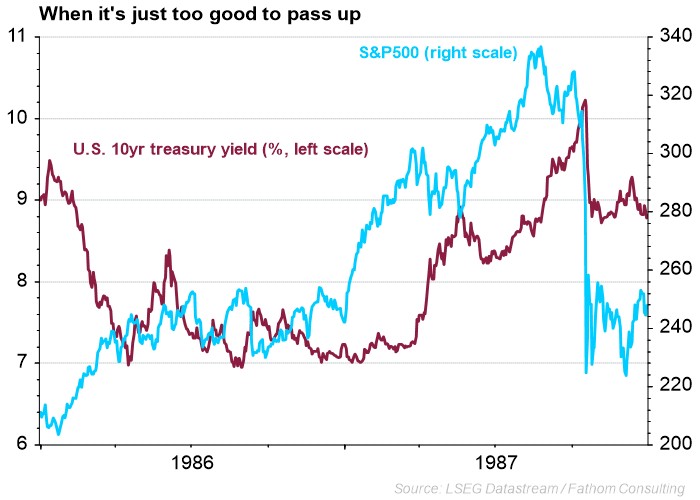
A 30-year Treasury paying north of 5% is a very different conversation than it was two years ago and there has been re-allocation of capital out of richly valued equities and into fixed income purely on a yield-attractiveness basis. For those of you youngsters that still have memories of October 1987, this was one of the factors that ended up knocking the valve out of the equity tire that autumn, as you can see in the chart below. Now, it’s also important to note that a 10% yield on a 10yr US bond was close to the historical average annual gain in the S&P500. If yields today stayed where they are (roughly half of where they got to in 1987), then Ed might have a point solely on the market interpretation. The economic angle is wrong though.
Where That Leaves Us
First of all, I don't think this is 2022 all over again. The starting point for yields is already elevated rather than coming off a decade of near-zero rates, which limits how much further this correction can realistically extend before value re-asserts itself. But it does mean duration (or, average bond portfolio maturity, if you will) needs to be handled deliberately right now, not defaulted into.
Bottom line: markets, like a late-August bike ride, don't always go according to plan. Tires blow, gentle hills feel steeper than they have any right to, and sometimes you finish the stretch on a bike two sizes too small in the rain. What matters is having a plan that survives the unexpected — and knowing when to hop on whatever gets you home.
On behalf of the Pyle Wealth Advisory team, have a great Labour Day weekend.
Andrew Pyle
Related posts
Andrew Pyle
July 03, 2026
There and back again
Markets in the first half of 2026 felt like a tough climb—steady gains, sharp descents, and unexpected turns. The ride mattered more than the distance covered.
Read moreAndrew Pyle
August 21, 2026
Who’s Actually in Tune with AI?
A guitar riff, a trade rant, and an AI reality check: the world is not adopting AI in harmony, and that mismatch may matter for markets.
Read more