




Andrew Pyle
August 28, 2026


Elbows Up, Gloves Off
On May 21, 1978, in Game 4 of the Stanley Cup Final, Montreal head coach Scotty Bowman sent out a lineup built to intimidate — Pierre Bouchard, Gilles Lupien, Rick Chartraw, wall after wall of size. Boston countered with Stan Jonathan, a winger who gave up several inches and thirty-some pounds to Bouchard. Six minutes in, the gloves came off. Bouchard landed the first shots and looked, for a moment, like the fight everyone expected. Then Jonathan switched hands, found his left, and didn't stop finding it — Bouchard's nose and cheekbone gave out before Jonathan did. It remains one of the most famous fights in Bruins-Canadiens history.
I keep coming back to that image this week when thinking of the trade “war” that has developed between the US and Canada. Actually, that’s not accurate. The “war” is between a narrow set of ideals embedded in the White House and Canada. As Trump’s argument goes, Canada is ripping the US off, even though Canadians buy more US products and services than Americans buy from Canada by a factor of around 7 to 1. Canada is not the bigger economy in this relationship, and no one should pretend otherwise. But “elbows up” was never a promise about the scoreboard — it's a posture. And, after the collapse of trade talks between the two countries a week ago, it feels like the gloves might be coming off whether we choose it or not. What follows is the itemized damage so far, what it might cost both sides, and why this is only one of several fights the current administration has picked at once.
Two separate tariff actions are now in motion — one already in force, one on a countdown clock. On the U.S. side, a 50% tariff took effect August 19 on an estimated $20–28 billion of Canadian exports, hitting hockey equipment, wine and other alcohol, cement, dairy, building materials, and select clothing, with energy, potash, and critical minerals carved out. Canada’s response, effective September 8, matches dollar-for-dollar, targeting steel, dairy, appliances, agricultural equipment, pulp and paper, and electronics — value still to be determined once matched to the U.S. total, with one carve-out of its own: fish, fish, and more fish. Notably, the U.S. side had reportedly been weighing cutting the existing steel and aluminum duties in half as part of the deal that ultimately fell apart — which tells you how close a materially better outcome actually was.
Canada came into this round of trade negotiations from a weaker economic position, relative to the US. That doesn’t mean Canada’s economy was in dire shape. Yes, there was a small contraction in real GDP during Q4 of last year and Q1 of this year. The Bank of Canada has taken this recent weakness into account, holding its policy rate at 2.25% since October, after a series of cuts through 2025 brought it down from a much higher starting point. The Bank's own language has shifted over the year from describing tariffs as a risk to describing the economy as actively adjusting to trade restrictions, with uncertainty now explicitly “wider than usual” in its own words. A fresh 50% duty on a $20-28 billion slice of exports, arriving on top of that, puts renewed pressure on the Bank to consider whether 2.25% is still “about the right level,” in Governor Macklem's phrasing — or whether this now tips toward another cut. That said, Canadian labour market activity is head and shoulders above that of the US and the jump in employment in July took most economists by surprise.
The United States enters from a messier inflation picture than markets would like. Headline CPI ran at 3.4% year-over-year in July, core at 2.5% — both above where the Fed wants to be — while the labour market has simultaneously cracked, with July payrolls down 23,000 and May/June revised down a combined 103,000. That combination — sticky inflation and a softening jobs market — already had the Fed's two mandates pulling in opposite directions before this week. Layering tariff-driven cost pressure on top of that doesn't make the September 15-16 FOMC decision any easier; markets currently price roughly a two-thirds probability the Fed holds, but that probability has been moving, and it's reasonable to expect it moves again as the tariff picture and the August CPI print (due September 10) both land in the same window.
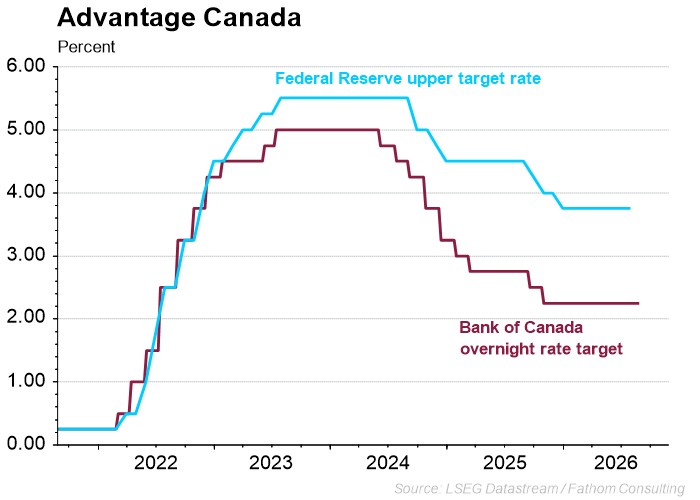
The above chart shows the Bank of Canada target rate against the Fed’s target. Considering current developments, the odds favour Canada’s policy rate holding and perhaps declining if the central bank deems it necessary to offset negative economic ramifications from this latest trade battle. Odds of a US rate cut are far below and this gap in policy reality is one reason why we see more insulation for Canada during this episode vis-à-vis the US.
The bigger-picture read is that this isn't inflationary in the way a global oil shock is, but it is a targeted cost-push on specific categories — dairy, alcohol, building materials, appliances — that will show up in the CPI baskets of both countries in a fairly traceable way over the next few months. But let’s get back to the central question – who wins this trade war, if it indeed continues? The answer lies less in which economy can endure more from a macro perspective, and more in where tariff pain is likely to be felt most quickly.
Given that Canada came onto the ice already with a collective view to shifting consumption patterns away from US products, one could argue that the net effect of tariffs may not be as severe as originally expected. Americans in certain states already facing higher costs from the effects of the US-Iran war, may have a different reaction function. That’s a good segue to my next section.
Zoom out, and Canada is not really a standalone story this year — it's the newest addition to a growing list of fronts the current administration has opened simultaneously, each with its own market fingerprint. Iran has kept a live geopolitical risk premium in oil markets for most of 2026, with the Strait of Hormuz repeatedly used as leverage and U.S. energy officials not expecting Gulf output to normalize until early 2027. The bond market has been sending its own signal — the 10-year term premium, essentially the extra compensation investors demand to hold long-dated U.S. debt through an uncertain decade, has been elevated for over a year now, and the Treasury's decision this month to expand its buyback program for long-dated debt is itself a tell: officials are managing around fragility in demand, not just funding routine issuance. China, by contrast, is the one front currently calm — Washington and Beijing extended their truce into a one-year arrangement after the two leaders met, with U.S. tariffs on Chinese goods cut from 57% to 47% and Beijing pausing new rare-earth export controls. Yet, with the recent announcement of actions to be taken against countries that aid Iran, China is not going to be quiet.
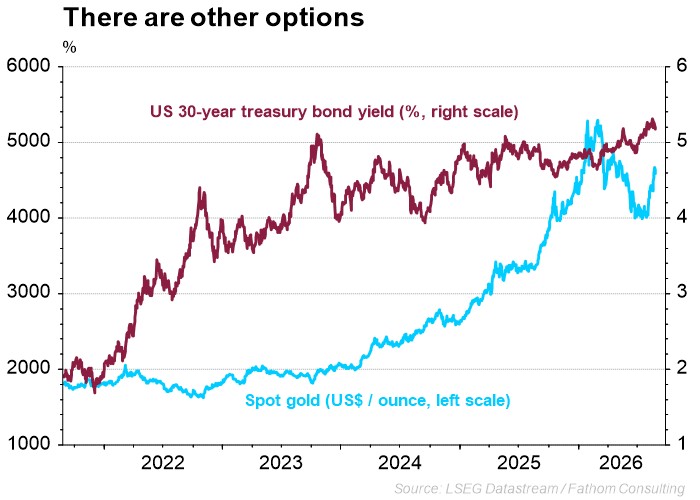
The focus may appear to be on AI and the Canada-US trade drama, but market participants have been pricing all of the above as a package, whether or not it's being discussed as one. Gold is up sharply this year and sitting near 15-week highs as I write this, a classic signal of investors reaching for a hedge against exactly this kind of accumulating policy uncertainty. The U.S. dollar index has fallen to its lowest levels since mid-May, even as Treasury yields on the long end sit near multi-decade highs — a combination that doesn't normally happen together, and one that reflects some genuine unease about U.S. asset demand more broadly, not just short-term rate expectations.
None of this means the sky is falling. Markets have absorbed each of these fronts individually without a disorderly event so far. But four simultaneous, self-initiated points of friction — one of them now with Canada, historically among the most stable relationships the U.S. has — is a different animal than any one of them in isolation.
But back to my opening. While that fight from 1978 stands out, it wasn’t because the smaller team won the series — Montreal took the Cup two nights later — but because size, on that night, wasn't destiny. Canada is one of the world’s ten largest economies. There are much smaller economies watching this unfold, with less trade concentration with the US than Canada and even less in common with the US than Canada. The question being asked is whether to get on the ice at all or simply look for another team to play with.
On behalf of the Pyle Wealth Advisory team, have a wonderful weekend.
Andrew Pyle
Related posts
Andrew Pyle
January 31, 2025
No disruptions please, we're central bankers
The Bank of Canada and Federal Reserve held their first policy meetings of 2025 and while the decisions and messaging were different, they share one source of uncertainty in common.
Read moreAndrew Pyle
March 20, 2026
Stuck between Iran and a hard place
Global central banks should have had an "easy" 2026, but the Iran war has put them in a bind. Fight inflation from higher energy prices or protect against recession. Talk about a tight spot.
Read more